
Creature
Manhandla
Poisonous Tree
Characteristics
Manhandla is a monstrous, spinning, man-eating flower with the ability to spit fireballs. Its defining characteristic is its four symmetrical mouths, which are its weak points. When each of its mouths are dispelled, Manhandla picks up speed, reaching its maximum velocity upon destruction of the third mouth. Once all four mouths are destroyed, the Manhandla is defeated.
The Legend of Zelda
In The Legend of Zelda, Manhandla is the Boss of Level 3, where it defends one of the Triforce Shards. Manhandla is later encountered as a mini-boss in Level 4 and as a standard enemy in Level 8. Manhandla appears more commonly during the Second Quest, including in Level 2, Level 5, Level 6, and Level 7.
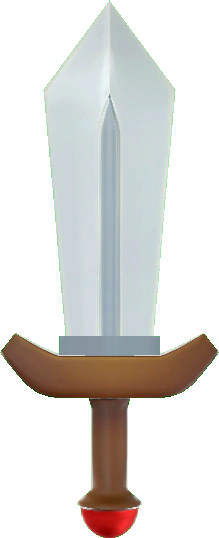
When fought, Manhandla has the ability to spit fireballs from all four of its heads, and it moves around erratically. Link must destroy all of them to defeat it. Each head has a health of 4, totaling the beast at 16 health. Manhandla is unaffected by the Boomerang and Fire. Link can damage Manhandla using his Sword, Arrows, the Magical Rod, or Bombs. Bombs are the most effective, as one is powerful enough to destroy Manhandla's heads in a single blast, so if the Bomb detonates in the center with careful timing, it can destroy all four heads at once, killing it instantly. As each head is destroyed, the Manhandla increases its speed and spits fireballs at a faster rate. As with other bosses, the Magical Shield cannot defend Link from Manhandla's fireballs. When Manhandla is accompanied by Stone Statues, the Statues also increase their rate of fire as each hand is destroyed. When defeated, Manhandla will drop a Heart Container and may drop either a Heart, a Fairy, or one Rupee.
Oracle of Seasons
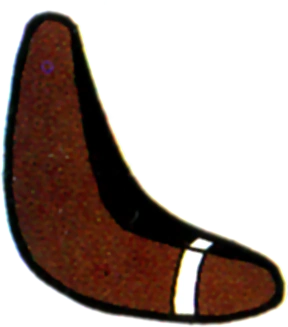
In Oracle of Seasons, Manhandla is the boss of the sixth dungeon, the Ancient Ruins. Manhandla starts out by spitting four fireballs at Link. The flowers can only be damaged by the Magical Boomerang when they are open. When Manhandla loses all four flowers, it moves around the room very fast, similarly to in The Legend of Zelda. Link has to continually hit Manhandla with the Magical Boomerang to expose its core. At that point, Link has a small amount of time to use his Sword to destroy Manhandla's core and defeat it. Link receives a Heart Container and the Blowing Wind as a reward for destroying Manhandla.

Manhandla's body is now a large Buzz Blob, which is very similar to the Giant Buzz Blob mini-boss from the Color Dungeon in Link's Awakening and to the Big Green Chuchu of the Deepwood Shrine in The Minish Cap. The four plant heads now look and act very similar to Piranha Plants from the Mario franchise, reflecting its origins as a relative.
Four Swords Adventures
In Four Swords Adventures, Manhandla appears in The Coast, Frozen Hyrule, and Realm of the Heavens, as either a Boss or Mini-Boss. The strategy is the same as in The Legend of Zelda, but the claws are different colors, and the Link of the corresponding color must strike the claw to destroy it. It takes one hit to weaken each claw, but if one of the Links get struck by it or hits the wrong head, Manhandla will spit fire from all four heads and they will grow to full size again. The Links must to repeat the process in that case. Once all the claws have become smaller it will be destroyed.

A larger variant of Manhandla, Big Manhandla, also appears, and it first appears in Four Swords, which regular Manhandlas are absent from.
Echoes of Wisdom
In Echoes of Wisdom, the Manhandla are the minibosses of the Faron Temple, encountered on two separate occasions. In the first battle, they appear with only two Manhandla heads and retreat upon defeat. The second encounter is more challenging, featuring four heads, two of which are significantly stronger. Defeating them in this second battle causes them to perish, rewarding Princess Zelda the Boss Key.

BS The Legend of Zelda
Manhandla also appears in BS The Legend of Zelda. The first time it shows up is in Level-3 as the Boss, then it returns in the seventh dungeon as a mini-boss. The battles play out in a similar manner to that in The Legend of Zelda, except for the fact that Manhandla is faster but requires fewer blows to defeat.
Hyrule Warriors
In Hyrule Warriors, Manhandla is a Giant Boss encountered in several Legend Mode and Adventure Mode stages. In Legend Mode, it appears as a Boss in the Scenarios "The Sorceress of the Valley", "Ganondorf's Return", and "Darkness Falls". As with previous incarnations, Manhandla appears as a bulb with four heads, however, its heads and body are covered in a sturdy metallic hide that deflects attacks.
While being fought, Manhandla can use a greater variety of attacks than in its previous appearances, possibly since Hyrule Warriors is their first appearance in a 3D game, but they can no longer spit fireballs. A Manhandla's attacks include spitting seeds that target the Allied Base; rapidly spitting seeds directly at its targets; lunging with its huge jaws; uprooting itself and rampaging around the battlefield while swinging its heads around; or spewing a pool of poison similarly to what Deku Babas can do. These attacks will also harm nearby enemy troops. Occasionally however, namely before lunging with its four heads or firing a seed upwards and right after its seed barrage, its heads will briefly lose their metallic hide and become organic. While Manhandla's heads are exposed, the player's warrior can throw the Boomerang at the heads to stun it. When all four heads are stunned, Manhandla falls and exposes a large crystal in its bulb, revealing its Weak Point Gauge. There is a very uncommon occurrence of Manhandla exposing its Weak Point Gauge even without all of its heads stunned. When defeated, Manhandla will usually drop the Manhandla's Toxic Dust, and rarely, the Manhandla's Sapling.

Sources
Adapted from the original article, under GFDL 1.3.