
Lore
The End of Ocarina of Time
The ending of Ocarina of Time has long been considered the cornerstone of the…
The ending of Ocarina of Time has long been considered the cornerstone of the Zelda Timeline, as the presence of the Hero of Time who went back and forth in seven years of time generated a fork in history, dividing Hyrule’s chronology. The official timeline describes the ending of Ocarina of Time as creating three parallel timelines:

The Downfall Timeline is the timeline in which Link, the Hero of Time, despite his best efforts, was defeated by Ganon in the final battle. This dark turn of events created the branch containing A Link to the Past, Oracle of Seasons and Oracle of Ages, Link's Awakening, A Link Between Worlds, Tri Force Heroes, The Legend of Zelda, and The Adventure of Link.
The Child Timeline is the timeline that follows Link after being sent back to his original time, following the Hero of Time's defeat of Ganondorf in the final battle. In his time, Link tells the young Princess Zelda of what would happen in the future and Ganondorf was soon captured. This turn of events created the branch containing Majora's Mask, Twilight Princess, and Four Swords Adventures.
The Adult Timeline is the timeline that follows the events after Link is being sent back to his original time, following the Hero of Time's defeat of Ganondorf in the final battle and is the original universe of Ocarina of Time. Ganondorf is sealed within the Evil Realm by the Seven Sages, but with Link sent back in time by Zelda, the world is ultimately left without a Hero. This turn of events created the timeline containing The Wind Waker, Phantom Hourglass, and Spirit Tracks.
Credit Sequence
After Link defeats Ganon and the Sages seal him in the corrupted Sacred Realm, Princess Zelda congratulates Link for his great heroic efforts but apologizes for her actions of trying to control everything. She then asks Link for the Ocarina of Time which she uses to send the Hero of Time back to the past where he's suppose to be and asks him to leave the Master Sword within the Pedestal of Time to seal the paths between the past and the future.
The following is a list of events as they occur chronologically during the ending credits of Ocarina of Time.
Kaepora Gaebora is shown flying across the Gerudo Desert.
The Gerudo's Fortress is shown but no guards are around.
Kakariko Village is shown but nobody is around.
The Death Mountain Trail leading to the Goron City is shown.
Darunia's room is shown.
Lake Hylia is shown.
Zora's Domain is shown.
The Deku Tree Sprout is shown.
Kokiri Forest is shown but nobody is around.
Hyrule Field is shown with Epona running across it.
Everyone is in Lon Lon Ranch at night celebrating Ganondorf's defeat with a big party by a colorful fire.
Talon and Ingo laughing and hugging with some dancing Kokiri, Gorons, and Zoras.
Some people from Hyrule Castle Town enjoying the party which include the Blue Juggler, the Red Juggler, the Buyer, and the Man Carrying Sack.
Three Kokiri playing with the Phonogram Man as the Running Man runs past them.
The Carpet Merchant, the Lake Scientist, and the Bean Seller on the Carpet Merchant's flying carpet with Granny and the Bombchu Bowling Alley Operator sitting behind them.
Malon with Epona teaching the Carpenters how to sing.
The Medicine Shop Owner, the Happy Mask Salesman, the Fishing Hole Man, and the Bombchu Shop Owner dancing.
The Cucco Lady juggling her Cuccos while Medigoron watches.
The Dancing Couple, some Gorons, some Gerudos, and Biggoron dancing.
Mido and King Zora sadly sitting on the ground not joining in the festivities due to believing that Saria and Ruto are gone. Until they both see five colorful lights flying across the sky.
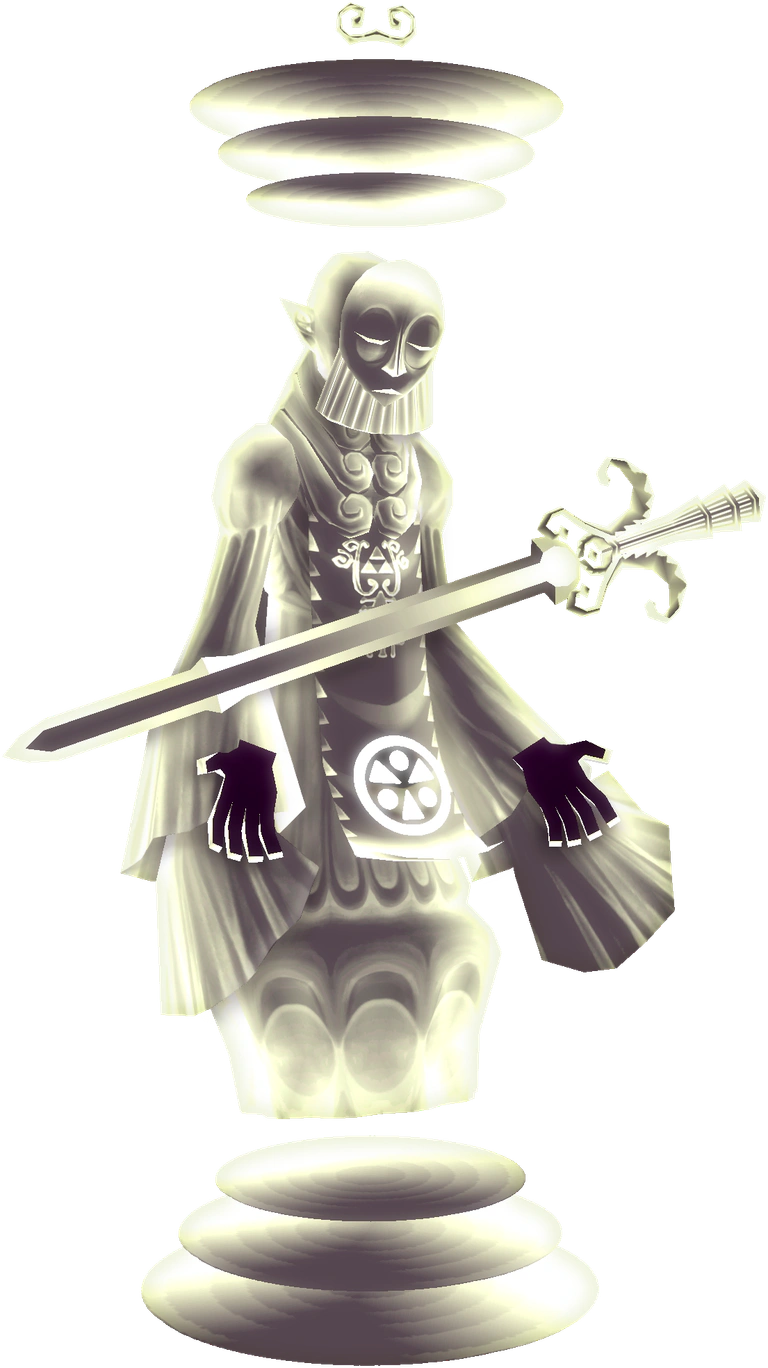
The lights reveal themselves to be the Sages and Link's childhood friends: Saria, Darunia, Princess Ruto, Impa, and Nabooru on the top of Death Mountain proudly watching the peaceful Hyrule from below.
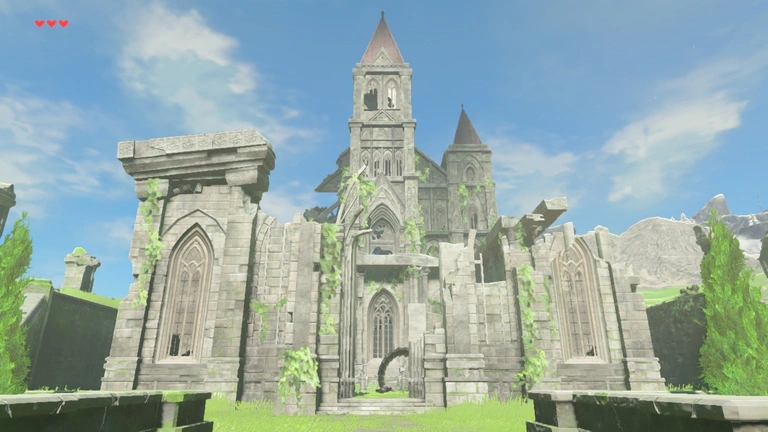
Link is permanently back in the past inside the Temple of Time with the Master Sword within the Pedestal of Time again. Navi leaves without saying a word now that their quest is complete. Then Link leaves the Temple of Time and the Master Sword.
Link visits young Zelda in the Hyrule Castle Courtyard a second time much to her surprise, with the Triforce of Courage resonating on his hand.
The Narrative
In Ocarina of Time, Link meets up with Princess Zelda in the courtyard of Hyrule Castle as a child; Zelda and Link look through the window and see the Gerudo king Ganondorf bowing before her father, Hyrule’s unnamed king. Zelda notes to Link that she had a dream that prophesied Ganondorf’s takeover of Hyrule by stealing the Triforce, but the King of Hyrule did not believe her story. After obtaining the three Spiritual Stones, Zelda sends Link to the Temple of Time to pull the Master Sword in order to prevent Ganondorf’s plans. As Link pulls the Master Sword, he was suddenly sealed for seven years, and Ganondorf is able to get into the newly-opened door to the Sacred Realm, touch the Triforce, causing it to split into its three component parts.
As an adult, in the future, Link witnesses Hyrule succumb to Ganondorf’s rule; just as Princess Zelda’s dream predicted, Ganondorf usurped the Hylian throne and sent the world into darkness using the Triforce of Power. With the Triforce of Courage, Link confronts Ganondorf, defeats him, and then the Sages seal him in the Sacred Realm.
Link is sent back in time to his childhood, before his original conversation with Princess Zelda. He tells her of his exploits in the future and the legitimacy of her dream. This information from the now-alternate future, in conjunction with Ganondorf's overconfidence, led eventually to his capture according to the backstory of Twilight Princess, creating a new future where Ganondorf doesn't take over and is eventually executed.
Terminology
In the subsequent analysis section, there will be several terms used that are integral to the understanding of the ending of Ocarina of Time.
• Old Past: the time period in which Link and Zelda are children, up to the point where Link pulls the Master Sword, and Ganondorf assumes the Triforce of Power.
• New Past: the time period in which Link and Zelda are children, Link returns from the future, and Ganondorf's wish to conquer Hyrule is not fulfilled.
• Future: the time period in which Link and Zelda are adults, Ganondorf is defeated and sealed in the Sacred Realm, and Link disappears from this era upon returning to his childhood.
Analysis
When is the "Child" timeline created?
The "Child" timeline is created when Zelda, using the Ocarina of Time and her powers as a Sage and the Triforce of Wisdom, sends the Hero of Time back in time in order to reclaim the years he lost, seemingly against his will. Since the time travel occurs through the Sacred Realm, Link returns again to the Temple of Time. More specifically, Link returns around the time of their original meeting. He proceeds to find Zelda at the same spot, spying at Ganondorf through the window.
It is interesting to note what a hypothetical observer would see at the point where the split occurs. If the observer followed Link in the new past, he would see him vanishing and appearing again in the Temple of Time. Although this happens at an instant, the difference is radical. Link, before vanishing, hasn't acquired the Triforce of Courage yet, and is not aware of the consequences of drawing the Master Sword from its Pedestal at his age. When Link reappears (from the player's perspective always), he now bears the Triforce of Courage and knows that if he draws the Master Sword his spirit will be sealed for seven years.
The last journey Link makes, when Zelda sends him back, can be considered unique. Previously, Link traveled several times in the past using the Master Sword, but no alternate timelines were created. As it seems, the Ocarina of Time coupled with Zelda's powers, had the ability to do that.
Why is there an Adult Timeline Split at all?
The Adult Timeline exists because Link is transported into a real future, given the foundational events in the old past. Since this would have been the natural progression of time, the people living in this time period are real as well, and go on living even through Ganondorf’s takeover of Hyrule as if their seven years had gone by naturally. Link is the only one that is not present for the span of time between the release of the Master Sword and his arrival in the future, so only he (and by extension, Zelda and Navi ) is aware of the apparent time difference. One must remember that during the seven years of Ganondorf's takeover, Link's spirit was withheld in the Sacred Realm, as he was not of age to become the Hero of Time when he initially drew the Master Sword. When Link travels back to the old past, it is also only he that disappears from the “future”, and only he that has a recollection of the “future” – Zelda and Ganon do not travel back in time, and appear as they are as if Link had never left. Because Link returns to the new past after defeating Ganon, this plotline of the future continues in which there is no Hero or Sages to face Ganon after he finds a way to escape from the Sacred Realm pre-The Wind Waker, many generations after Ocarina of Time's events.
In the end, the future, though initially founded in the “old past”, is only spiritually related to that time period; however, the inhabitants of the future are unaware a timeline split was even created. Only Link and Zelda are fully aware of the breaches in time, though only Link experienced it. This aspect of timeline theory is integral to the split timeline – because we experience Ocarina of Time vicariously through Link, the player is also objectively aware of the split timeline; to any other character in the game, it would seem as if life occurs linearly – there’s no evidence to suggest any other NPC, outside of those mentioned earlier, knows that Link actually traveled in space and time to their “present”.
How is the "Downfall" timeline created?
While the "Child" timeline is the result of Link returning to his original time at the end of the game, the creation of the "Downfall" split is not a result of a time-travel. Instead, in a similar fashion to how the cells multiply (one splits into two, each one then is divided further etc.), from an original universe which contained the events up to Link challenging Ganondorf in battle, two parallel universes were created: one in which Link was victorious and another where Link is defeated, giving Ganon the chance to obtain the complete Triforce, which leads to his subsequent sealing within the corrupted Sacred Realm by the seven Sages and later to the Imprisoning War. However, unlike the other two timelines, this is only possible during gameplay, as there is no cinematic or cutscene for this event in-game.
It is possible that the Zelda universe is actually composed of many more parallel universes/realities than those included in the official timeline, all of them together forming a "multiverse". According to this view, there is nothing special about the point where Link challenges Ganondorf. Instead, it is just one of the many branching points in the history of Hyrule. The reason we don't see the multiverse in its entirety is because:
It should be noted that in fictional works at least, this type of multiverse does not necessarily contain every conceivable outcome. Those deemed unrealistic, such as Link being defeated by weak enemies, can be omitted.
1) it would be practically impossible for all the parallel universes to be included due to their very large number, and
2) there aren't currently any games taking place in them.
Aftermath
At the moment Link returns to the Temple of Time in the new past, two alternate universes are created in which:
The first postulate is the foundation for the Adult Timeline Split that leads into The Wind Waker. The opening story of The Wind Waker describes the triumph of the Hero of Time from Ocarina of Time, and how Ganon was able to return to Hyrule, unopposed, after adult Link returned to his own childhood. Two other games are confirmed to take place during this timeline: Phantom Hourglass and Spirit Tracks, both being sequels to The Wind Waker.
The second postulate is the foundation for the Child Timeline Split that leads into Majora's Mask and Twilight Princess. Majora’s Mask occurs several months after Ocarina of Time and describes how Link’s childhood search for his fairy companion, Navi, led him into an alternate world, Termina. The scene in Twilight Princess which depicts Ganon's execution occurs several years later.
Ganon acquired the Triforce of Power in both branches of the timeline, but in different ways. In the Adult Timeline Split, he entered the Sacred Realm and since he witnessed the Triforce splitting, he was aware that he got the Triforce of Power. In the Child Timeline Split, Ganon was unaware that he had it, up to the point where the Triforce activated and revived him after being stabbed by the Sages.
In the Adult Timeline, Ganondorf, unlike Link and Princess Zelda, was not a chosen bearer, rather he obtained a Triforce piece simply because he touched the Triforce.
1) Ganon is defeated by Link, and sealed in the Sacred Realm by the Seven Sages. Link disappears, the Triforce is still split into its component parts.
2) Ganon's true intentions are now known to the King, Link and Zelda are children, the Triforce is split into its component parts. The latter is evident in the scene near the ending when Link's Triforce mark glows. It seems that Link had to keep his piece when he traveled back in time. Each piece is bound to its own branch of the timeline though, so in order for Link to retain the Triforce of Courage, when he arrived in the Temple of Time, the Triforce in this branch of the timeline split and as a side-effect Ganon acquired the Triforce of Power. The Seven Sages, who banish a defeated Ganondorf in the Adult Timeline and a triumphant Ganon in the Fallen Hero Timeline, are not called to their vocation, so are not present when Ganondorf returns.
The "Divine Prank"
Due to the fact that the Sages collaborate with the Royal Family, who was informed by Link of the "future" events, they most likely knew that Ganon had acquired the Triforce of Power in the Adult Timeline. In the Child Timeline, they didn't expect that the Triforce of Power would choose Ganondorf as its bearer. The "divine prank" was that ironically, the god-created laws, allowed a man like Ganondorf to obtain a Triforce piece.

Sources
Adapted from the original article, under GFDL 1.3.