
Work
The Legend of Zelda: Breath of the Wild
Nineteenth main installment of The Legend of Zelda series
The Legend of Zelda: Breath of the Wild is the nineteenth main installment of The Legend of Zelda series. It was released simultaneously worldwide for the Wii U and Nintendo Switch on March 3, 2017. Multiple patches and DLCs were also released in the years after the main release.
"BotW" redirects here. For the Dungeon, see Bottom of the Well.
Story
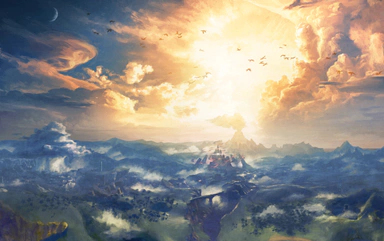
Link awakens from a deep slumber and a Princess Zelda guides him to discover what has become of the ruined land of Hyrule. Link leaves the Shrine of Resurrection and looks out at Hyrule on top of the Great Plateau. Link then meets an Old Man by a campfire. The Old Man promises Link his Paraglider, which is the only way to get down from the plateau. However, he first wants "treasures" from nearby Shrines. They are called the Oman Au Shrine, Ja Baij Shrine, Owa Daim Shrine, and the Keh Namut Shrine. After Link obtains these treasures, revealed to be Spirit Orbs, the Old Man returns with new instructions. He tells Link to meet him in the Temple of Time, then mysteriously disappears. Upon meeting him in a tower atop the Temple of Time, The Old Man reveals himself as the spirit of the deceased King of Hyrule, King Rhoam. Link learns from King Rhoam that 100 years prior, a great evil known as the Calamity Ganon rose up and laid waste to the kingdom and its people, the Hylians. Unable to be defeated, it was sealed within Hyrule Castle, while the ruins of the land were ravaged by nature over time. Although trapped, the Calamity Ganon has grown in power, and Link must defeat it before it breaks free once more and destroys the world. The mysterious voice from the Shrine of Resurrection turns out to be Zelda, the daughter of King Rhoam. After escaping the confines of the plateau, Link is directed to meet the wise Sheikah elder Impa, and learn about the Guardian and Divine Beast: 10,000 years prior these machines were created and successfully used by another Hero and another Princess to defeat the Calamity Ganon. But throughout the ages, knowledge about the ancient technology was lost until excavations in Hyrule brought them to light once more, coinciding with the expected return of Calamity Ganon a hundred years ago. The Guardian were reactivated and four Champions were chosen to control the Divine Beast: the Zora princess Mipha, the Goron warrior Daruk, the Gerudo chief Urbosa, and the Rito archer Revali. All the while, Zelda was unsuccessfully trying to gain access to her own prophesied powers, accompanied on her quests by her knight, the Hylian Champions Link. When the Calamity Ganon ultimately attacked, it devastated the Kingdom of Hyrule by taking control of the ancient Guardians and turning them against the Hyrulean. As a last resort, Zelda was able to place the gravely wounded Link in the Shrine of Resurrection and use her awoken sealing powers to trap herself with Calamity Ganon in Hyrule Castle, without knowing it might wipe all of Link's memories.
As Link sets off on his quest to defeat Calamity Ganon, he is asked to investigate the fate of the Divine Beast and their former Champions. His ultimate goal remains to reach the Calamity Ganon and free the trapped Zelda before the whole world is laid to waste. But with the entire Kingdom of Hyrule before him to explore, it is up to Link himself to decide how he wishes to fulfill his foretold role as the Hylian Champions, and to save Hyrule Kingdom.
Open World
Breath of the Wild features a vast open world for Link to explore. Most of Hyrule's scenery is accessible by walking, paragliding or climbing. While the game still includes barriers (such as weather effects, inhospitable environments or strong enemies), many of these can be overcome by using Food, effective weapons and armor or finding alternate routes. The world also includes an elaborate physics system which allows for creative interactions (e.g., cutting down a tree and using its trunk as a raft on a river, or setting grass ablaze and spreading the fire with wind gusts).
Unlike many previous Zelda games, Breath of the Wild does not enforce a specific order in which quests or dungeons have to be solved, with the exception of completing the starting tasks on the Great Plateau. It is possible to challenge Ganon right after leaving the starting area, though the game does encourage exploration in order to solve Ancient Shrine (and thus gaining additional Hearts or Stamina), find useful and powerful equipment, and defeat the game's own version of dungeons, the Divine Beast. Additionally, many of the game's puzzles can also be solved in various different ways, often rewarding Link for creative solutions.
Controls
Link's controls in Breath of the Wild are reminiscent of previous 3D Zelda games. However, the game is the first to require manual jumps as opposed to auto-jumping over small gaps which was introduced with Ocarina of Time and a long-time staple of The Legend of Zelda series. Holding the Attack (Y) button will allow Link to perform a spin attack. Pressing Jump (X or B) and then Attack (Y) will result in a jump attack.
Combat
Link is able to use many combat abilities in conjunction with his Rune.
Flurry Rushes
In combat, Link can dodge to the left or right, or backflip out of the way of enemy attacks. When timed perfectly, it initiates a Flurry Rush. This will allow Link to chain multiple uninterrupted hits while in slow motion.
Perfect Parry
When holding a shield, by performing a Parry with the right timing, he is also able to Perfect Parry, negating all damage and using no durability. Depending on the shield strength, enemies will have different reactions, from staggering to dropping their weapon.
Bullet Time
When sufficiently high enough above the ground, drawing your Bow will activate Bullet Time and slow down time. This allows you to shoot with more accuracy and fire rapid shots before the enemy can respond.
Cooking
A feature introduced with Breath of the Wild is Cooking, which enables the creation of Food that recovers Hearts and bestows various effects on Link. Meals are cooked by broiling up to five edible Material at cooking pots, such as meat, berries, fruits or herbs. Elixirs can be mixed by including monster parts in various recipes. Depending on chosen ingredients, Link's health will be replenished and/or he will receive effects such as Elemental Resistance, additional Stamina or Hearts, or buffs to his Defense, Attack, or Speed potency.
Equipment & Durability
Link can equip a vast variety of different Equipment in Breath of the Wild, including Weapon, Bow and Arrow, Shield, and Armor, allowing for adaptation to the ever-changing environment of Hyrule and tactics used by different enemies. Notably, almost all Weapon, Bow, and Shield found in the game will break after a certain amount of hits. (Contrary to popular belief, the durability value of any weapon is not the number in the bottom right corner of the weapon icon.) This new Durability system often forces Link to use Equipment salvaged from enemies, even weak ones, instead of just wielding the best Sword available in the game. Equipment that has not been used at all, and thus has sustained no damage, is indicated by a sparkle on the top-right corner of its icon in the Inventory screen. An Equipment that is close to breaking will have a flashing red icon, and a brief notification will appear whenever it is taken out.
Rune Abilities
Completing the initial four Ancient Shrines on the Great Plateau bestows Link with four Rune: Magnesis, Stasis, Cryonis and Remote Bomb. These abilities allow Link to manipulate the environment by lifting magnetic objects, freezing objects (and later enemies) in time, creating blocks of ice on water surfaces, and summoning bombs. Other Runes, such as the Camera, can also be found. Together with climbing and paragliding, these abilities are used throughout the rest of the game and (for the very most part) sufficient to solve puzzles and access most of Hyrule. As a consequence, the game does not feature traditional dungeon items that grant abilities to Link.
Exploits
For a full list of exploits and glitches able to be performed in Breath of the Wild , visit Glitches in Breath of the Wild.
Bullet Time
When slowing down time using Bullet Time, most entities move 19x faster. Their momentum is then multiplied 19x when Link exits Bullet Time. However, if an object gains momentum while in bullet time, upon exiting Bullet Time, it's momentum is multiplied 19x. This allows for a variety of movement exploits, including:
Windbombing- This technique involves shooting a Remote Bomb into Link, causing the bomb to gain intense momentum and send Link flying.
Bullet Time Bounce (BTB)- This technique involves shield surfing off a frozen enemy to create a small amount of directional upwards momentum, and then exiting Bullet Time to multiply it, giving massive launch power.
Clipping- If Link is touching a wall and performs this exploit, the momentum will clip Link into the wall if timed carefully.
Combat
There are many exploits that allow Link to gain an advantage over an enemy. These include:
Thunderclap Rush- This exploit involves overloading Link's weapon state while engaged with an enemy, enabling an instant Flurry Rush without needing to dodge.
Shield Block Reset- This is a technique used to get easy Bullet Time while in close combat. It involves jumping into an enemy's attack with your shield, effectively resetting Link's stance, allowing him to essentially 'double-jump' and achieve Bullet Time on relatively flat ground.
Daruk's Perfect Parry- This revolves around Daruk's Protection. It essentially allows the player to use Daruk's Protection infinitely.
Development
The Zelda HD Experience, a The Legend of Zelda tech demo of the Wii U, was shown at E3 2011. In June 2011, Shigeru Miyamoto confirmed that Nintendo is planning on creating an HD The Legend of Zelda title. Development of Breath of the Wild started immediately after the development of Skyward Sword ended.
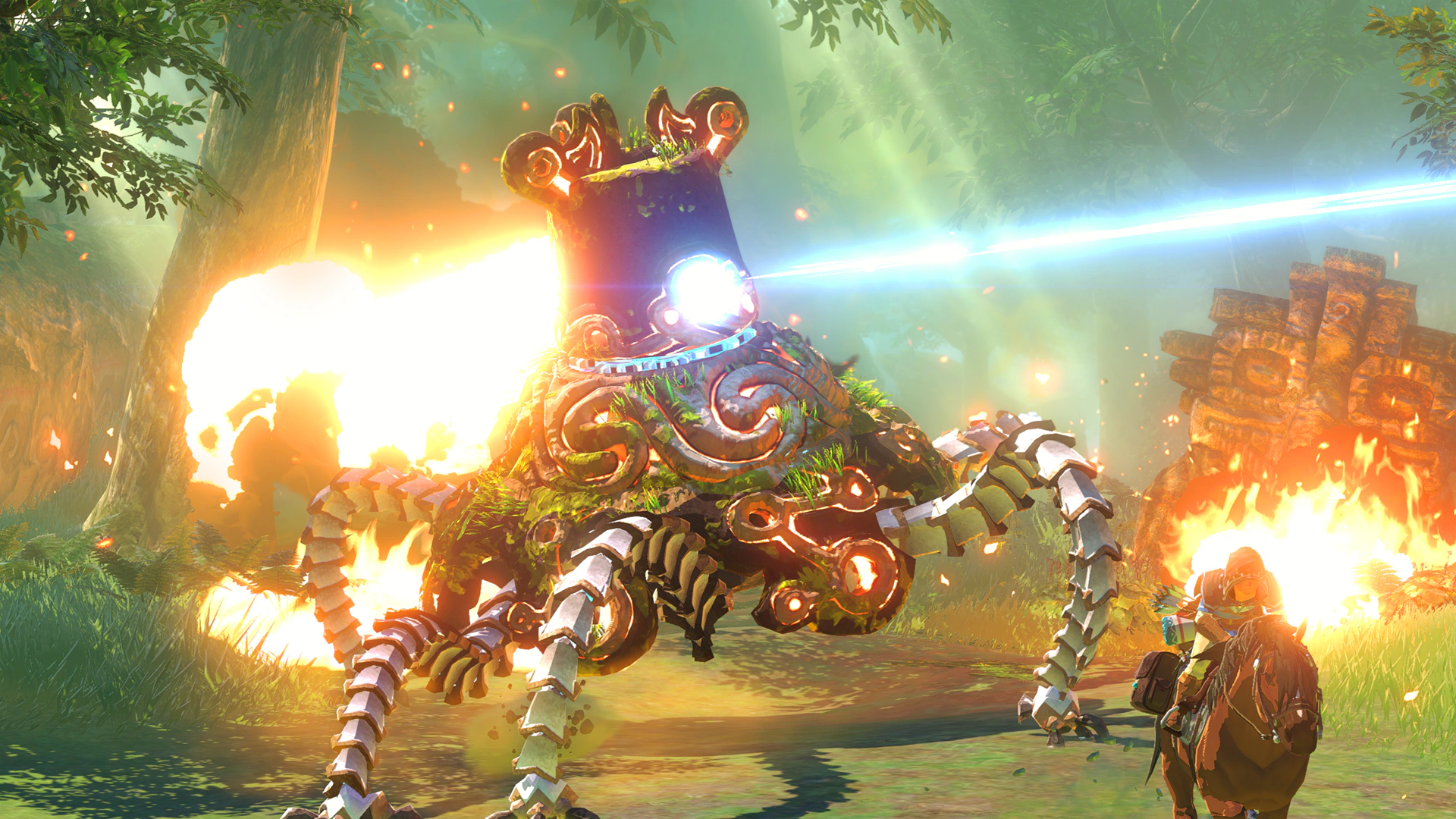
Breath of the Wild was officially announced in a Wii U Direct presentation on January 23, 2013. Eiji Aonuma stated that the game intended to challenge what was expected of The Legend of Zelda franchise, such as having to complete dungeons in a specific order. The game was already expected to have a long development time, so Nintendo released The Wind Waker HD for the Wii U to decrease the gap between releases. During E3 2014, the first video of the game was shown, revealing Link riding a horse, in addition to a Guardian and Hyrule Field. During the Game Awards 2014, Miyamoto and Aonuma showcased another gameplay video. It demonstrated the scale of Hyrule, which was designed with the open world concept of the original The Legend of Zelda in mind. It also showed the first use of the Paraglider, map features, as well as additional riding and fighting mechanics. Features to be used on the Wii U gamepad were also shown during these videos, which were later removed during development, when the game was ported to Nintendo Switch.
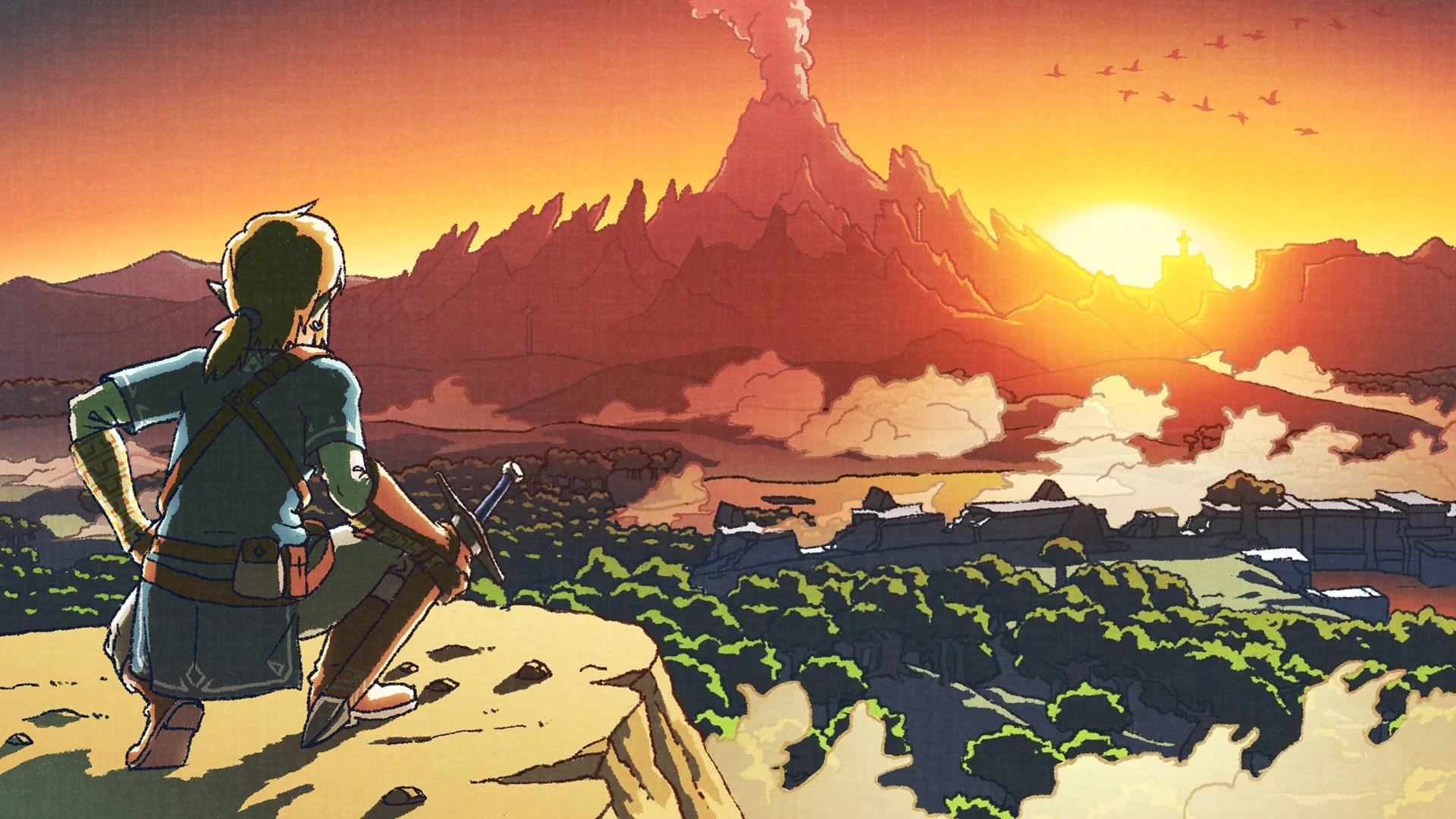
The game's original release was intended for 2015, but as new ideas were implemented during development, the release date was pushed forward several times. The final release window of the game was first revealed in financial documents released in March 2016, and later confirmed by Nintendo via Twitter.
During E3 2016, the game's first playable demo was made available for visitors. It featured the Great Plateau area and showed many new elements of the game, such as Perfect Dodging, the creation of Food by collecting Material, the use of enemy Weapons, the return of the Stamina Gauge, new mini-Dungeons called Ancient Shrines and the Sheikah Slate.
Nintendo revealed the final March release date of Breath of the Wild during the Nintendo Switch presentation in January 2017. Shortly afterwards, on February 9, 2017, the game was completed after more than five years of development.
A sequel to Breath of the Wild was announced during the Nintendo Direct at E3 2019.
Release
Breath of the Wild was released simultaneously worldwide for the Wii U and as a Nintendo Switch launch title on March 3, 2017. The game was later released in Taiwan and South Korea on February 1, 2018, only for the Nintendo Switch. The game is the last Nintendo-published title on the Wii U platform.
A version of Breath of the Wild including the Expansion Pass was released in Japan on October 8, 2021.
Special Editions
Various special and limited editions for the Switch version of Breath of the Wild were released worldwide.

On November 17, 2017 an Explorer's Edition of the game was released in Mexico and later on in North America and Japan on November 23. This edition featured the game, a 100-page explorer's guide, and a two-sided map. On September 28, 2018 a Starter Pack was released in North America also featuring the game and the explorer's guide. No special edition for the Wii U version of the game was released.
In North America, the Special Edition included the game, a tapestry map, a Sheikah Slate carrying case, a soundtrack with 24 songs, and a Sheikah Eye coin. The Master Edition included the same content as well as a Master Sword statue.
In Europe, the Limited Edition included the game, the soundtrack, and the Master Sword statue.
In Australia, the Limited Edition included the game, the tapestry map, the soundtrack, the Sheikah Eye coin, and the Master Sword statue.
In Japan, the Collector's Edition included the game, the Link (Rider) amiibo, the soundtrack, the tapestry map, and an interchangeable alternate cover. The Deluxe Collector's Edition included the same content as well as the Master Sword statue and 20 postcards.
Pre-Order Bonuses
Several retailers offered bonus items for pre-ordering the game. These included a black t-shirt featuring the Sheikah Eye in the Nintendo Official UK Store, a Z icon keyring and a poster featuring artwork from the game in GAME retailers, a wristband in Grainger Games, two double-sized art cards in Argos, and a pin badge in ShopTo. In GameStop retailers, a poster featuring the game's cover artwork was included.
Version Differences
The Nintendo Switch version has a few benefits over the Wii U version, but is otherwise identical. The game's performance and loading times are better on the Nintendo Switch due to the more powerful hardware, and it further reduces loading times on Switch by overclocking the console's CPU. The Switch's hardware also allows the game to run at a resolution of 900p in TV Mode, while the Wii U can only run the game at 720p.
The Switch version has higher audio quality; the game's audio files have a sample rate of 32000 Hz for Wii U, and 48000 Hz for Switch. The Wii U version requires a DLC to use all the language options that are included in the Switch version by default. In updates, the Switch version exclusively received support for Chinese (Traditional), Chinese (Simplified), and Korean languages, as well as a mode to play the game using Nintendo Labo VR.
Timeline Placement
The plot of Breath of the Wild directly refers to events that take place 10,000 years and 100 years prior to the game's setting, also known as the era of myth. Before the game's release, Eiji Aonuma revealed that Breath of the Wild takes place after Ocarina of Time. In an interview following the game's release, Aonuma touched upon the idea that details of the history of Hyrule may have changed from previous games, similar to how real-world history books are often revised. In an interview with the game's director, Hidemaro Fujibayashi, he stated that Breath of the Wild takes place in the most recent age, long after the previous games. In an interview with Jeuxvideo, Eiji Aonuma clarified that though Breath of the Wild does take place somewhere on the timeline, its exact placement has not been decided, as definitively placing it during development might limit their ability to further develop the story. In a Famitsu magazine interview with Eiji Aonuma for The Legend of Zelda: Twilight Princess HD, Aonuma noted that Twilight Princess HD was the origin point for Breath of the Wild and that while playing Breath of the Wild players may have realizations about elements from Twilight Princess HD.
Many references and connections to previous games in the series can be found throughout Breath of the Wild. These include the presence of the Rito who evolved from the Zora in the Adult timeline, the history of the Zora, which tells the tale about the Sage Ruto who aided the hero in his fight against Ganon. The "Subdued Ceremony" Recovered Memory shows a speech by Zelda which contains references to Skyward Sword, Ocarina of Time, and Twilight Princess, as well as to A Link to the Past and The Wind Waker in Japanese and German. Many locations are also named after characters and landmarks, such as Arbiter's Grounds, the Temple of Time, and Darunia Lake.
The history section of The Legend of Zelda: Breath of the Wild – Creating a Champion includes an "Age of Myths", which refers to Ganondorf becoming Dark Beast Ganon, and his defeat and sealing by the hero and the princess, eventually giving rise to the Calamity. However it notes that due to such a long time having passed, and historical records having been destroyed during the Great Calamity it is impossible to tell which legends are historical fact and which are mere fairy tale. Tears of the Kingdom would go on to reveal that at least part of this history was incorrect, as the Ganondorf who became the Calamity was sealed away by Rauru, not Link and Zelda.
Amiibo Support
Breath of the Wild is compatible with all lines of amiibo figures, scannable by using the amiibo Rune ability, which can be activated via the game's options menu. All regular amiibo will grant random items and Material, while most of The Legend of Zelda-related amiibo will summon treasure chests, containing rarer and sometimes exclusive items (like costumes or special weapons related to the respective games). Additionally, Epona and Wolf Link may be summoned into the game, using the Super Smash Bros. Link and the Wolf Link amiibo, respectively.
A line of Breath of the Wild amiibo figures was also released on the same date as the game, making it the second mainline Zelda game (following Twilight Princess HD) with its own line of amiibo. The figures include two versions of Link, Zelda, a Bokoblin and a Guardian, all featuring their in-game design. This line continued with four amiibo released for DLC; Mipha, Revali, Urbosa, and Daruk. Each amiibo is based on the character's artwork and unlocks a helm based on each Divine Beast.
Updates
Several free patches have been released for both the Wii U and Switch versions of Breath of the Wild. These updates expand content and patch certain bugs. Unlike the DLC packs, these are downloaded free and automatically upon release.
An initial download intended for the retail Wii U version of the game containing extra game data is required to be installed in order to run the game. The update requires 3 GB worth of space to be installed.
Update Release Date Content - Version 1.1.0 March 2, 2017 - Version 1.1.1 March 30, 2017 - Version 1.1.2 April 11, 2017 - Version 1.2.0 May 1, 2017 - Version 1.3.0 June 29, 2017 - Version 1.3.1 August 7, 2017 - Version 1.3.3 November 9, 2017 - Version 1.3.4 November 21, 2017 - Version 1.4.0 December 7, 2017 - Version 1.5.0 January 31, 2018 - Version 1.6.0 April 25, 2019
Adds Downloadable Content and eShop access to the title screen.
Bug fixes.
Bug fixes.
Adjustments to Master Kohga's AI.
"Infinite Arrow Glitch" fixed.
Bug with Wolf Link fixed.
Allows voice language to be changed in the title screen's Options menu between nine languages.
Wii U version requires Option to Change Voice Language to be downloaded from the eShop.
Adds The Master Trials DLC Pack.
Bug fixes.
Adds the "Tips from the Wild" news channel to the Nintendo Switch version of the game. Set to be opened on August 9, 2017.
Bug fixes.
Bug with Medals of Honor fixed.
Adds compatibility with the four Champion amiibo.
Adds the Xenoblade Chronicles 2 Side Quest to obtain the Salvager gear.
Bug fixes.
Bug with the Game Over mark in Hero's Path Mode fixed.
Allows DLC items to be bought from Granté
Bug fixes.
Adds The Champions' Ballad DLC Pack.
Bug fixes.
Adds support for Chinese (Simplified), Chinese (Traditional), and Korean text to the Nintendo Switch version of the game.
While using these languages, selecting "Match System Settings" for the Voice Language Option will use the Japanese voice data.
Bug fixes.
Adds support for the VR Goggles from Nintendo Labo Toy-Con.
Reduces loading times.
Expansion Packs
An Expansion Pass, offering paid downloadable content for Breath of the Wild, was made available upon launch for both the Wii U and Nintendo Switch versions. The Expansion Pass includes two content packs which are not available to purchase individually, as well as additional chests with an exclusive item as a bonus for purchasing the pass. The regular price for the entire DLC is $19.99 USD (¥2500, $28.19 CDN, €19.99, £17.99, $30.00 AUD, $33.00 NZD).
The Expansion Pass content is divided as follows:
+ Pack Release Date Content - Expansion Pass Bonus March 3, 2017 shirt]] with the Nintendo Switch logo. - 'The Master Trials ~ DLC Pack 1 ~
June 30, 2017 - 'The Champions' Ballad ~ DLC Pack 2 ~
December 7, 2017
Trial of the Sword — a multi-level gauntlet against many enemies
Hero's Path Mode — tracks Link's steps within the last 200 hours
Master Mode — a mode of greatly increased difficulty for the game
Travel Medallion — allows a custom travel waypoint to be placed
New Armor can be acquired from chests found around Hyrule:
A new main quest giving additional backstory to the Champions, plus upgrades to their abilities upon completion
The Final Trial — a new Dungeon with a unique Boss, Monk Maz Koshia
16 new Ancient Shrines and four more Spirit Orb
The One-Hit Obliterator weapon
The Ancient Bridle — adds additional spurs to a Horse
The Ancient Saddle — allows a Horse to be summoned almost anywhere
New Armor can be acquired from Chests found around Hyrule:
Sources
Adapted from the original article, under GFDL 1.3.


