
Work
The Legend of Zelda: Ocarina of Time
The Legend of Zelda: Ocarina of Time is the fifth main installment of The…
The Legend of Zelda: Ocarina of Time is the fifth main installment of The Legend of Zelda series and the first to be released for the Nintendo 64. It was one of the most highly anticipated games of its age, and is listed among the greatest video games ever created by numerous websites and magazines. It was released in Japan on November 21, 1998, the United States on November 23, 1998, Europe on December 11, 1998, & Australia on December 18, 1998. It is the first game in the long-running franchise to display 3D graphics.
Widely considered to be a masterpiece, it most famously scored the first perfect 40/40 score in Famitsu Magazine - a feat that only 26 games (including The Wind Waker, Skyward Sword and Breath of the Wild) have ever achieved. In addition, G4 television declared it "the #1 game of all time" as well as Nintendo Power. Ocarina of Time is listed in Guinness World Records - Gamer's Edition 2008, as the highest ranked game of all time. In the 2010 Gamer's Edition, Ocarina of Time was updated as "the most critically acclaimed game of all time." It is also the highest scoring game of all time on Metacritic, at 99/100. It has also been ranked the greatest video game of all time by dozens of other publications. Therefore, like its contemporary Super Mario 64, Ocarina of Time is universally considered one of the most important and influential games of not only the Zelda franchise but the video game industry as a whole, and is essentially a repeat of The Legend of Zelda in terms of revolution for the action-adventure genre but in 3D. With 7.6 million copies sold worldwide, for 19 years, this installment was the best-selling standalone title of the series until Breath of the Wild in 2017 - itself selling a whopping 35.3 million (primarily due to being a launch title for the Nintendo Switch).
An altered, more difficult version called Master Quest was released for the Nintendo GameCube through Collector's Edition. At E3 2010, a remake of the game for Nintendo 3DS was announced, called Ocarina of Time 3D. The remake was released in June 2011 and it includes Master Quest with the addition of mirrored gameplay. As with most older Zelda games, the original version has been re-released multiple times through Virtual Console and Nintendo Switch Online.
The Legend of Zelda: Majora's Mask is the game's direct sequel, while The Wind Waker is its indirect equivalent.
This article is about the game. For the item, see Ocarina of Time (Item). For other uses, see Ocarina of Time (Disambiguation).
Events leading up to Ocarina of Time
Approximately ten years before Ocarina of Time's story begins, there was a war known as the Hyrulean Civil War. This war explains the origins of several characters and provides extra backstory to their motives.
The Boy Without a Fairy
In the Kokiri Forest, all the forest children have their own guardian Fairies, bestowed upon them by the Great Deku Tree, except for one boy named Link. Link has recently been plagued by nightmares of Princess Zelda fleeing from an evil man clad in black on horseback. For as long as he can remember, Link has been ostracized by the Kokiri and has never quite fit in, except for one girl named Saria. One day, the Great Deku Tree sends Navi the fairy to summon the boy to him. In order to test young Link's courage, the Great Deku Tree bids Link to venture inside his hollow and break the curse cast upon him by a "wicked man dressed in black."

Link complies, but his efforts are for naught; the Great Deku Tree's death was sealed in the pages of fate before the hero's adventure had even begun. With his final breath, the Great Deku Tree bestows upon Link the Spiritual Stone of the Forest, the Kokiri's Emerald, and entreats him to travel to Hyrule Castle and meet with Princess Zelda.
After traveling across Hyrule Field and passing through Hyrule Castle Town, Link does not take long to realize that speaking to the princess of Hyrule will not be a simple matter; many guards stand watch, alert and ready to catch any trespassers. However, he manages to infiltrate the castle, bypassing the front gate and evading all of the guards in his path. When he reaches the castle itself, the raised drawbridge seems like an insurmountable obstacle. However, Link discovers an unguarded water drain by the castle moat and manages to crawl through the hole, emerging within the castle garden. Many more guards are on patrol here, but Link is able to dodge all of them and sneak into the Castle Courtyard. In this Courtyard, his fate converges with that of the young Princess of Hyrule.
Princess Zelda tells Link of her prophetic dreams, explaining that she had actually seen the young hero come from the forest and break through a veil of darkness, accompanied by a Fairy guide and bearing the Kokiri's Emerald. She also warns him about Ganondorf, the man clad in black whom Zelda believes is symbolized by the dark clouds of her dreams, and his evil intention to steal the Triforce of legend from the Sacred Realm. With the power of the Goddesses, his desire to subjugate the world would be realized. In order to do this, Ganondorf would require not only the three Spiritual Stones of Hyrule, but also the mystical Ocarina of Time (Item). Zelda insists that Link should track down the other two Spiritual Stones, so that they might beat Ganondorf to the Triforce and put an end to his wicked ingenious plot. Here, he soon meets Impa, the loyal attendant of the princess and a member of the Sheikah.
Link sets out for Death Mountain and Zora's Domain, where he succeeds in assisting both the Gorons and the Zoras (particularly Darunia and Princess Ruto) in quelling the calamities that Ganondorf had wrought in his pursuit of the Triforce and is awarded with the other two Spiritual Stones, the Goron's Ruby and Zora's Sapphire for his efforts.

He returns to Hyrule Castle to inform Zelda of his success, only to witness his ominous nightmare he experienced at the very beginning of his quest become a reality; Ganondorf attacked Hyrule Castle (likely murdering the King of Hyrule in the process) in an attempt to steal the Ocarina of Time, and Princess Zelda was forced to flee with Impa on horseback in order to keep the Triforce from Ganondorf's hands. As she passes the young hero on the drawbridge of Hyrule Castle Town, she quickly throws the Ocarina into the moat to give him the chance to enter the Sacred Realm and retrieve the Triforce. In hot pursuit, Ganondorf himself charges across the drawbridge on horseback, blasting Link with dark magic when he tries to stand in his way. Dismissing Link as no credible threat to his power, he speeds off in pursuit of the princess. Link then looks on in frustration.
When Link retrieves the Ocarina of Time from the moat, he receives a telepathic message from Zelda, telling him that she won't be around anymore and to play the "Song of Time" in front of the Temple of Time's altar. Link makes his way to the Temple of Time and proceeds to use the three Spiritual Stones and play the Song of Time to open the Door of Time. Beyond it lies the legendary Master Sword, also known as the Blade of Evil's Bane, resting in the Pedestal of Time. Link draws the magical blade, unlocking the gateway to the Sacred Realm. Despite the Master Sword accepting Link as its wielder, it suddenly seals the young hero away in the Sacred Realm. Ganondorf, who had suspected that Link might have already acquired the keys to the Sacred Realm, secretly followed him, appears, and mocks him for leading him to the Triforce. Link watches helplessly as Ganondorf crosses over into the Sacred Realm with an evil laugh.
The Hero of Time
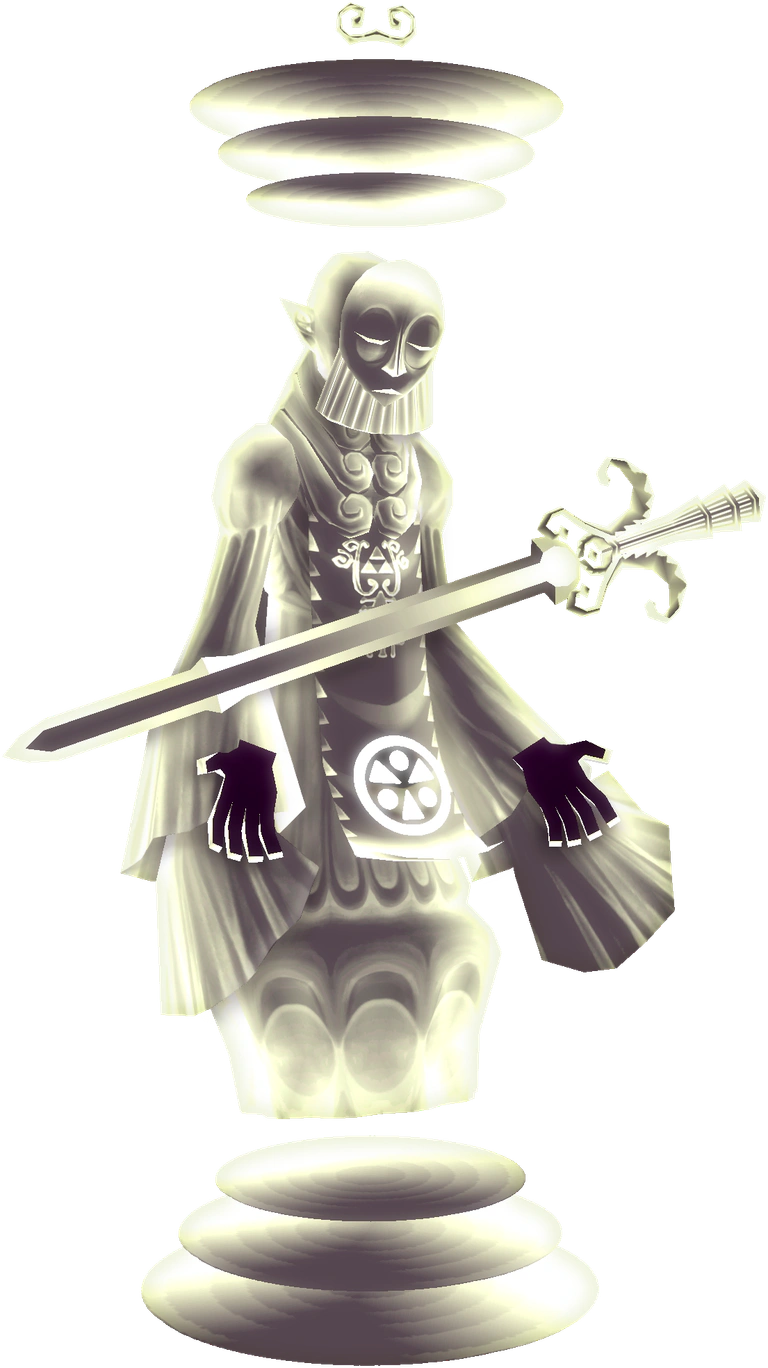
Seven years later, a grown-up Link is awakened by an old man in the Chamber of Sages. He introduces himself as Rauru, and reveals himself as one of the ancient Sages that preside over the Sacred Realm. Rauru explains that only the "Hero of Time" can pull the Master Sword from its Pedestal. However, Link was too young to be this title, so his spirit was sealed in the Sacred Realm for 7 years until he is mature enough to be accounted for. Rauru further reveals that Ganondorf obtained the Triforce after gaining access to the Sacred Realm, and used its great power to transform Hyrule into a land of darkness. Rauru urges Link to seek out the remaining Sages, and grants the hero his power in the form of the Light Medallion.

Link returns to the Temple of Time, where he is greeted by a mysterious young man named Sheik, one of the few survivors of the ancient Sheikah tribe. He tells Link of Ganondorf's conquest over the last seven years, and of the legend of the Sages. He urges the hero to awaken the five remaining Sages in the five Temples mentioned in the legend, which are scattered throughout Hyrule. Wielding the Blade of Evil's Bane, Link sets out to break the curse on all of the sacred Temples and awaken the new Sages within, who are each revealed to be his friends he aided during his childhood, and in turn, bestowed the hero more power with their own Medallions like Rauru.

After all Six Sages are eventually awakened, Link, the Hero of Time, returns to the Temple of Time and encounters Sheik once again. Sheik tells Link another legend of the Triforce passed down by the Sheikah. The Triforce itself is a grand scale that measures the three virtues ruled by the Golden Goddesses: Power, Wisdom, and Courage. If the heart of someone who holds the sacred triangle carries all three of these forces in balance, that person will acquire the Triforce intact, the divine authority to govern all. If one's heart is not in balance, the relic will separate into three parts, and only one part will remain for the one who touched the Triforce: that part which embodies the force that one most believes in.
If the one with an unbalanced heart would seek the full Triforce, then that person must strive to acquire the two lost parts, which will rest within two others chosen by destiny who will hold the crest of the goddesses on the backs of their hands. When Ganondorf laid his hands upon the Triforce, the prophecy came to pass; The Triforce indeed split into its three parts, and only the Triforce of Power remained in Ganondorf's hands. Ganondorf proceeded to conquer the Sacred Realm, and became the self-proclaimed King of Evil, but his lust for power was not yet satisfied. Ganondorf began hunting for those chosen by destiny to obtain the other two pieces of the Triforce that had escaped his grasp. Sheik reveals that Link himself wields the Triforce of Courage, and ultimately sheds his disguise to reveal his true identity as Princess Zelda, the seventh Sage as well as their leader who wields the Triforce of Wisdom. Finally meeting the hero in person, the now-grown Zelda tells Link that she thought that giving him the Ocarina of Time in the past would be the best way to keep it out of Ganondorf's grasp. However, she did not predict that the villain would follow Link into the Sacred Realm and take the Triforce of Power for his own. Zelda forcefully disguised herself as a Sheikah like Impa to hide herself from Ganondorf, and patiently waited seven years for Link to return. Princess Zelda then tells the Hero of Time that the six Sages must seal Ganondorf inside the Evil Realm, in so that she herself must ultimately seal the door to the Sacred Realm itself to keep him imprisoned for ages to come. The princess also gives the young hero Light Arrows to aid their goal. However, in now at last revealing herself to Link, Zelda also fully exposes herself to Ganondorf, who has been waiting for such a moment. The King of Evil promptly encases her within a large magic crystal and brings her to his castle, constructed where Hyrule Castle had stood in the past before its destruction. Link rushes to Ganon's Castle to save the princess for a final showdown.

The Final Confrontation
Upon entering Ganondorf's location, Link breaks the barrier around the castle with the help of the six awakened Sages (who themselves were also captured and must be rescued). Storming the keep, he confronts Ganondorf, and a fierce and climactic battle unfolds over the fate of Hyrule and the Triforce. The castle soon collapses, forcing Link and Princess Zelda to evacuate to safety, and the villain even becomes the Demon King Ganon, his actual form, in the aftermath after leaping from the rubble. Eventually, Link and Princess Zelda are victorious.

Without a strong and righteous mind, Ganondorf cannot control the power of the gods, and is ultimately defeated by Link's hand. With their power now fully restored, the seven Sages cast the evil incarnation of darkness into the void of the Evil Realm that had been the Sacred Realm before being stained by Ganondorf's evil. Zelda then seals the gateway, ultimately imprisoning the Evil King within the Sacred Realm. Before he is sealed away, the villain, in utter shock of himself being beaten entirely, angrily warns Link and Zelda that he will return to exterminate their descendants when the seal is broken (foreshadowing The Wind Waker), as he, unfortunately, still has the Triforce of Power in his hand.
While saying goodbye, Princess Zelda instructs Link to place the Master Sword back in its Pedestal and close the Door of Time, closing the road between the two timelines, and she sends him to his original time to regain his lost childhood. During the ending credits, the future Hyrule, thanks to Ganon's defeat by Link, is now at a longtime peace while the other Sages happily look on at Death Mountain. After Link returns to the past for good, Navi leaves him, as her mission of guiding the young hero to save Hyrule is completed. Link himself still retains all of his knowledge about Hyrule's fate throughout his adventure. With this invaluable information, he immediately visits the young Princess Zelda at Hyrule Castle's courtyard once again in order to prevent such a fate from ever occurring again (foreshadowing Majora's Mask and, eventually, Twilight Princess). The game then ends. Link, who traveled through time to save the land, would be forever known in legend as the Hero of Time.
Third Dimension
Although slightly outdated in comparison to the latest 3D The Legend of Zelda installments, the gameplay of Ocarina of Time was revolutionary for its time that has since become standard for most subsequent titles (and many other games inspired by it). It has arguably made more of an impact on the franchise than any of its predecessors, even though they each had the same cores of exploration, dungeons, puzzles and item usage. Notably, many elements in-game are directly taken from earlier titles while adding new ones. Some of its innovations over the previous 2D games include the Targeting mechanic which allows Link to easily target objects/characters and fight individual enemies without relying on free movement, cinematic cutscenes between certain events, voice acting (though a small degree), the hero reacting to damage more clearly, riding Animals (specifically horses) and the introduction of the "Action button," which has different uses depending on Link's environment; for instance, standing next to a door prompts the Action button to change to "Open," allowing Link to open the door.

The 3D environment, enhanced sound, and greater graphical capacity of the Nintendo 64 allowed Nintendo to create a truly immersive environment beyond what had ever been done before, allowing for greater separation between cheerful environments, such as Hyrule Castle Town and Kokiri Forest, and comparatively dark areas such as the Shadow Temple and Ganon's Castle.
Time Travel
Among the game's particular gameplay mechanics, one of the most noteworthy is the time-traveling system. The game is divided into two periods within a 7-year gap. In the first - the past, the protagonist Link is a child, and his mission is to retrieve sacred stones that are the key to open the Door of Time, where the Blade of Evil's Bane, the Master Sword, lies. As a child, he explores a rather peaceful Hyrule, the dangers he faces are not too concerning, and the dungeons are not too complex. In the second period - the future, Link is a young adult, and has to visit temples to free the Six Sages whose goal is to ultimately seal Ganon from the world of light. This is because the Gerudo King turned Hyrule into a much fiercer land, thus most regions of it suffer from curses that affect the inhabitants in various ways. Other differences between these two periods are the tools, items and treasures available.

Because of this, some parts cannot be accessed by Child Link or Adult Link, the sidequests vary, Child Link cannot use adult weapons, and Adult Link cannot enter small holes. Both periods, from a point of the game onwards, can be alternated anytime; in fact the only way to clear the game is to properly take the actions corresponding to each version of Link. This is similar to the Light World/Dark World dichotomy from A Link to the Past, and thanks to its notability in the game, Adult Link in this title widely became a trademark image of the series' main character for most fans of the franchise, despite the majority of Zelda games featuring Link himself as a child.
Music and Transportation
Ocarina of Time also introduces the use of music to solve puzzles. This mechanic would later appear in Majora's Mask, The Wind Waker, Twilight Princess and Spirit Tracks. As new songs are learned, they can be used to solve puzzles, gain access to new areas and warp to different locations.
The game also introduces Epona, a horse Link can travel with after retrieving her from captivity in Lon Lon Ranch; she is very useful for travel in Hyrule Field, and there are certain sidequests that require her assistance. Epona can only be used in the adult parts of the game, as she is too young to carry children in the child timeline (despite she can in Majora's Mask).
Equipment
Link can also change his equipment through the pause subscreen. Over the course of his adventure, Link may find different swords, shields, boots, and tunics. Many areas can only be explored when the hero is correctly equipped.
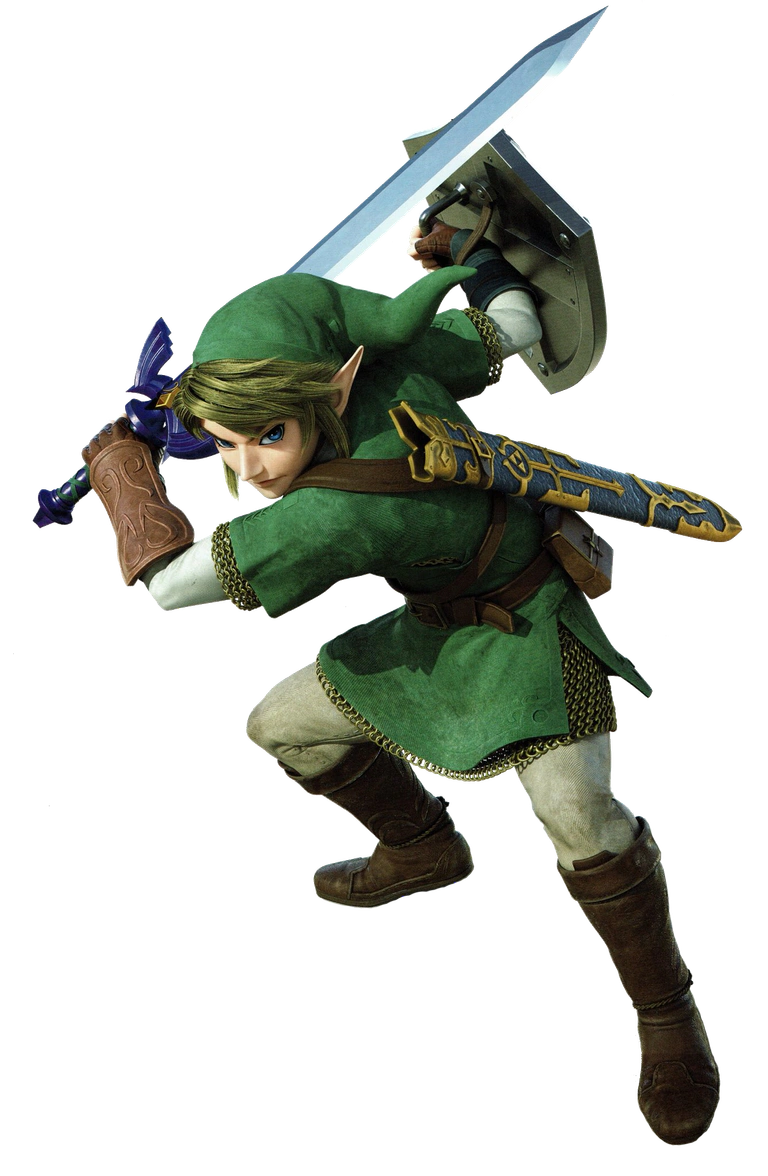
As a child, Link is initially equipped with the Kokiri Tunic and the Kokiri Boots. Early in his quest, he obtains the Deku Shield and the Kokiri Sword. Link may acquire the Hylian Shield later on, but due to it being too big for him, he cannot properly use it. After transforming into an adult, Link keeps his Kokiri Tunic and Boots, but is no longer able to equip the Kokiri Sword and Deku Shield (can now correctly use the Hylian Shield). During his adult quest, he acquires the Goron Tunic to withstand extreme heat and the Zora Tunic to breathe underwater. Link also receives the heavy Iron Boots used to sink to the bottom of bodies of water, and the Hover Boots to hover in midair briefly. Link also finds the mighty Mirror Shield, which allows him to reflect light and magic. Optionally, Link can also obtain the more powerful Giant's Knife or Biggoron's Sword.
Other items, which remain stacked for a permanent effect on Link, including the Goron Bracelet as a child, the Gauntlets as an adult (each allowing him to lift stronger objects, from Bomb Flowers to giant rocks), and Zora Scales to dive deeper underwater. Link may also obtain a collection of bag upgrades for Bombs, Arrows, Bullet Seeds, Deku Nuts, and Rupees.
Development
In 1995, Ocarina of Time was originally intended and designed for the Japan-only Nintendo 64DD peripheral for the Nintendo 64 game console. Initially named Zelda 64 (possibly The Legend of Zelda 64), it was supposed to be the flagship title of the 64DD, while Super Mario 64 of the Mario series was to be the counterpart for the main system itself. However, as the release of the 64DD became progressively delayed, Nintendo chose to move Ocarina of Time to a standard N64 cartridge with 32 MB of storage, only half the size of the 64DD disks, however it is still the largest cartridge ever produced for Nintendo systems up to that time, which saved most of the important content. This shift from 64DD disk to N64 cartridge contributed to the game being delayed significantly, resulting in the final game being released two years after the Mario title. At one point, the game was planned to be a first-person title, but was changed into a third-person perspective to keep Link visible on screen at all times.

In early stages of development, the game was structured similarly to Super Mario 64, with Hyrule Castle or Ganon's Castle as the only setting, and various different rooms in the castle serving as the dungeons, according to series creator Shigeru Miyamoto. Although this was scrapped for the final release, the Forest Temple's design has leftovers of the game's original plot, as it seemingly takes place inside a dark castle and the boss room to battle Phantom Ganon has multiple portraits of a night sky featuring Ganon's Castle in the background. Twilight Princess and to an extent Majora's Mask are also known to have taken beta gameplay elements from this game.
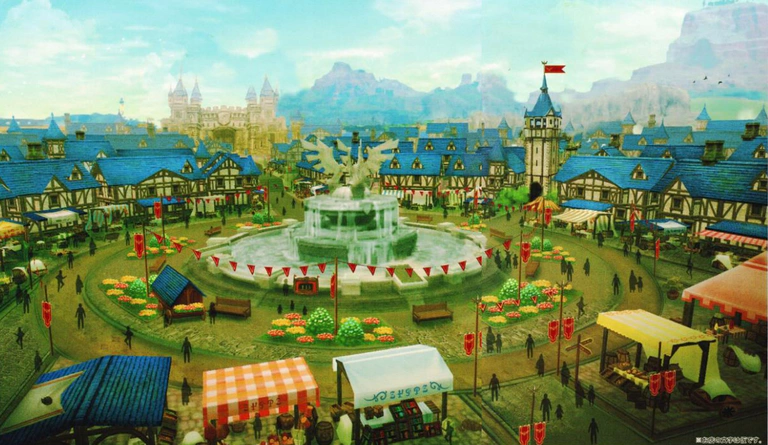
When creating Hyrule Castle Town Market, Shigeru Miyamoto visited Germany for inspiration of its medieval half-timbered architecture in Lower Franconia, spending a few weeks in northern Bavaria. Initially the Deku Scrubs were added as a character named "Hobbit" inspired by J. R. R. Tolkien's The Lord of the Rings.
Graphics
Being the first 3D Zelda game of the long-running series, a new engine was used for both this game and eventually Majora's Mask. Because the engine is based on polygonal graphics, they would require a significant amount of memory in the cartridge, and generating the graphics with simultaneity and consistency would imply the sacrifice of other aspects, such as music or textures. To solve this difficulty, some techniques were used so that the game wouldn't have any problems in this regard: When the camera is facing forward, the game only loads the memory of what is in that direction, be it enemies, characters or simply the space of the territory placed there. This means that there is literally nothing currently loaded on the sides not being witnessed by the camera angle. This technique is still used today in modern games with large overworlds.
Audio
Despite being a 3D game, there is no voice acting from the characters, with some slight exceptions: Navi when she is calling Link, Link himself when he yawns or sneezes, when he is shocked or when he sustains damage. A few characters scream, such as Ganondorf, Sheik and Link when he falls from high altitude, or laugh, such as Princess Zelda, Ganondorf, Saria and Malon.
Like the earlier 2D Zelda games, Ocarina of Time has its music composed by Koji Kondo. Surprisingly, the main theme of The Legend of Zelda series is mainly absent in this game, as the overworld tune (heard in Hyrule Field, Death Mountain Trail, Lake Hylia or Zora's Fountain) for this game is new. The game also uses interactive music: Normally, a background theme correspondent to where Link is can be heard; when an enemy is close to him, however, a particular combat theme can be heard (which does have a small portion of the main Zelda theme when in the overworld), and won't stop until the enemy is defeated or he moves a certain distance away. In a similar way, the aforementioned overworld theme also changes if Link remains still for some time. Kondo also composed the Ocarina melodies with only five tones of the first three musical notes.
Save Mechanics
The game can be saved at any point through the Subscreen. This will save the game's progress and items obtained up to that point. Upon the loading of a save file, Link's location will revert to one of several possible locations, depending on the progress made and where the game was last saved.
Link's House: If Link is a child when the game is saved, and was not in a dungeon, he will start in his house in Kokiri Forest regardless of his prior location.
Temple of Time: If Link is an adult when the game is saved, and was not in a dungeon, he will start in the Temple of Time regardless of his prior location.
Dungeon Entrance: If the game is saved while in a dungeon, loading that save will return Link to the entrance of that dungeon, regardless of his progress within it. This includes Ganon's Castle.
Setting
Ocarina of Time is the first title in the franchise to show Hyrule in three dimensions. The sacred land is a vast region that portrays various different ecosystems, which are populated by Hylians and other races. Hyrule Field is the central territory, and is connected to the other areas. It also surrounds Lon Lon Ranch, where milk is produced and where numerous animals are raised. Located east from the field is Kokiri Forest, where Link lives (and where the game begins) along with the Kokiri race (who inhabit the place and, as long as they do so, do not age); the forest is governed by the Great Deku Tree until his death early in the game. Found north of the field is Hyrule Castle Town, where most of the Hylians live, and where Princess Zelda is raised until her turn comes to lead Hyrule. It's also where the Temple of Time was built to house the legendary Master Sword.

East from Hyrule Castle Town is Kakariko Village, a place formerly inhabited by the Sheikah tribe until Impa made it public for people to live there, and where the Graveyard houses the remains of the deceased Royal Family members. Kakariko Village itself is the starting point to reach Death Mountain, the rocky home of the proud Goron race, as well as the fierce Dodongo population, and where an active volcano can be accessed. Northeast from Hyrule Field is Zora's Domain, a crystalline river and fountain inhabited by the Zoras and governed by King Zora until Princess Ruto takes the throne to accept her royal duty. Lake Hylia, found south from the Field, is not ruled by any race, but the Zoras did build a Water Temple in the Lake itself. Finally, Gerudo Desert is located west from the Field, and consists of a Valley, a Fortress, a Haunted Wasteland, and the surroundings of a Temple. It is inhabited by the Gerudo tribe, and is considered to be a ground isolated from the rest of Hyrule.
Initially, most of these areas are relatively safe from evil, and the few exceptions (Kokiri Forest, for example) have problems too specific to cause any major impact on its inhabitants, mostly having to do with the search of the Spiritual Stones. Seven years later, however, every single part of Hyrule is affected greatly by Ganondorf's evil influence, so Link as the Hero of Time must visit the sacred Temples so that the Sages can be awakened and the curses can be undone, one by one.
Changes Between Versions
Five different versions of the game were produced for the Nintendo 64. Three versions were made for Japan and North America and two for Europe. The Japanese and North American (NTSC) versions themselves are identical aside from a byte that sets the game's region and determines the language of the game. Several minor changes were made between each version, with a variety of text corrections and glitches fixed. The original versions are known as the v1.0 and v1.1 NTSC builds.
Corrections and changes were made in version 1.2 (Player's Choice release) and the European (PAL) versions, as well as the recoloring of Ganondorf's blood from red to green, and the alteration of the music heard in the Fire Temple to remove a sample of an Islamic prayer chant. The sample was taken from a commercially available sound library, but the developers did not realize it contained Islamic references. Contrary to popular belief, the chanting was not removed due to public outcry, but instead after Nintendo discovered it violated their own policy to avoid real-world religious material in games. All five Nintendo 64 versions of Ocarina of Time were completed prior to the game's original release date of November 21.

A further modified version of 1.2 was produced for the Nintendo GameCube re-release. The original Crest of the Gerudo, as depicted on blocks, switches and the Mirror Shield, was changed from an inverted star and crescent symbol (associated with Islam) to a unique design introduced in Majora's Mask, which became standard for the series since. Further alterations were made to the game's dialogue, along with minor technical changes. The Virtual Console and Nintendo Switch Online re-releases of the game are identical to the version released for the GameCube, but with the original Nintendo 64 button colors.
Special Edition
Between December 1998 and 1999, a Special Edition bundle was released exclusively by German mail order company Cyber Games. It included a physical copy of the game, a T-shirt with the Ocarina of Time logo on the front and a unique artwork of Link on the back, a relief pin in the shape of the Master Sword and a Hylian Shield with the word "Zelda" stamped onto it and a gold butterfly clutch, and a flyer promoting merchandise by Cyber Games. These are extremely rare, as only a few examples exist today.

Timeline Placement
When it comes to the Zelda Timeline, Ocarina of Time is likely the most important and decisive installment among the franchise, which is attested by both its placement and the connections with past and future games. According to the book Hyrule Historia, it is indicated to be the final Zelda game in the pre-split timeline era, which starts with Skyward Sword (which, shortly after its official announcement, was confirmed to take place before Ocarina of Time). The other games preceding Ocarina of Time are The Minish Cap and Four Swords. Regardless, Ocarina of Time has always been a pivotal game in the chronology with the events at the end of the game, where Princess Zelda sends Link back to his youth, splitting the timeline into two. When the official timeline was revealed in Hyrule Historia in 2011, the placement of Ocarina of Time in the series was revealed to be of even greater value, as the events of the game actually split the series' timeline into three branches, which the third being possible based on whether Link defeated Ganon or not.
"Downfall Timeline"
At the end of Ocarina of Time, there was one possible outcome in which Ganon actually defeated Link, which resulted in the formation of the "Downfall Timeline". It starts with the Hero of Time, Link, failing to defeat Ganondorf, which allowed the Evil King to ultimately obtain the remaining Triforce pieces from Link and Princess Zelda. Despite losing their great beloved hero and the villain is victorious, the Seven Sages still proceeded to quickly seal him within the corrupted Sacred Realm like in the game's actual ending. Years later, greedy people entered the Dark World seeking the Triforce, turning into monsters and becoming part of Ganon's army. In the war that ensued, the Knights of Hyrule protected the Seven Wise Men of that era from Ganon's minions, while they cast a seal to close off the entrance to the Dark World. This marked the conclusion of the Imprisoning War, which laid the foundation for the events of A Link to the Past. After A Link to the Past, Link's Awakening, Oracle of Seasons and Oracle of Ages, A Link Between Worlds, Tri Force Heroes, Echoes of Wisdom, The Legend of Zelda, and The Adventure of Link take place, in that order.
"Child Timeline"
If Link succeeds in defeating Ganon, the timeline branches into one of two more timelines. When Princess Zelda sends Link back to his original time, the "Child Timeline" is formed. Although Ganondorf is not granted access to the Sacred Realm, it is very possible that unbeknownst to him, he acquired the Triforce of Power as a result of Link returning back with the Triforce of Courage still in his possession (as well as Zelda gaining the Triforce of Wisdom). Link informs Zelda of the "future" events and leaves Hyrule shortly afterwards to search for Navi, setting the events of Majora's Mask in motion. Ganondorf is then executed several years later according to the backstory of Twilight Princess. Over a century later, the events of Twilight Princess take place and the Link in this game lingers on as the Hero's Spirit due to his soul-shattering regrets of not being remembered as the Hero of Time at all. Following Twilight Princess, Four Swords Adventures takes place featuring Vaati and another incarnation of Ganondorf.
"Adult Timeline"
In a third branch of the events in Ocarina of Time, similar to the "Child Timeline", the "Adult Timeline" continues after Link defeats Ganon and the Sages seal him in the Sacred Realm with the Triforce of Power in his possession. Link is sent back to his childhood by Zelda, ultimately leaving the future Hyrule in this branch without a Hero, as told in the prologue of The Wind Waker. Hyrule was at a longtime peace for many generations and the Hero of Time's legend was fondly remembered, but Ganon eventually overcomes the Sages' seal and attempts to take over Hyrule once more. With no hero to face the evil at all, the kingdom was easily conquered and, as a last resort, the Golden Goddesses flood Hyrule, leading to the events of The Wind Waker and consecutively Phantom Hourglass, and later in the timeline, Spirit Tracks.
Ports and Remakes
• See also: Changes Between Versions
GameCube Ports
Ocarina of Time was ported to the GameCube twice. Once was for a pre-order bonus for The Wind Waker, in which customers would receive Master Quest (The Wind Waker/Ocarina of Time/OoT: Master Quest bundle was available as a "limited edition" general release in Europe, in addition to preorders). The second time was for a special GameCube bundle that came with Collector's Edition.
iQue Player
Ocarina of Time was ported to the Chinese iQue Player (a localized version of the Nintendo 64) released in 2003. The dialogue was fully translated to Chinese. This marked the first Zelda game to become available in China. The game is downloaded to the iQue Player using a points card. The iQue version of Ocarina of Time is based on version 1.2. Lag is virtually non-existent due to iQue's more powerful hardware. This is most noticeable during the collapse of Ganon's Castle cutscene, where the castle falls at such a speed that the audio falls out of sync.
Virtual Console
Ocarina of Time has been ported to the Virtual Console on both the Wii and Wii U.
On the Wii Virtual Console, the Japanese and American 1.2 and European 1.1 Nintendo 64 version was available for download for 1000 Wii Points. The Virtual Console does not support the rumble feature, which renders the Stone of Agony useless. Although based on the Nintendo 64 version, it still contains the changed moon and star symbols, as it uses the GameCube ROM. This is due to a patch which was put in the Virtual Console emulator which changes them.
On the Wii U Virtual Console, the game was available for download for approximately $10.
3DS Remake
A Nintendo 3DS remake of Ocarina of Time was announced by Nintendo during the E3 2010 conference. Various tweaks were made to the popular title besides improved graphics, including a new system for equipping items, specifically the Iron Boots and the constant swapping necessary in the Water Temple and the introduction of the Shard of Agony in place of the Stone of Agony, which alerts Link of hidden caves using a sound effect rather than a rumble.
Nintendo Switch Online + Expansion Pack
Ocarina of Time is one of the Nintendo 64 games included in the Expansion Pass for Nintendo Switch Online.
Sources
Adapted from the original article, under GFDL 1.3.