
Person
Luigi
Mario's younger, taller and more cowardly twin brother
Yay for me, Luigi!
Luigi is Mario's younger, taller and more cowardly twin brother. Luigi has assisted and fought alongside his brother on many occasions. Throughout his life, he has lived in Mario's shadow, developing both cowardly and heroic tendencies. Luigi first appeared in the Game & Watch title Mario Bros., shortly before his major debut in the arcade game of the same title. Originally a color swap of Mario, Luigi was created to facilitate a second player option. Over time, Luigi had gained his own identity and personality, especially since the release of Luigi's Mansion.
Luigi was born when Shigeru Miyamoto set out to create Mario Bros. after being told Mario resembled a plumber, a notion he wanted to officially establish. For this particular adventure, however, Miyamoto wished to incorporate a two-player mode. : Miyamoto's answer to Joust's stork-riding Player 2 was Luigi, Mario's green-clad younger twin brother with whom he could compete or cooperate. With 2-player mode in mind, Nintendo and publishing companies such as Atari gave Luigi immediate publicity, making him the star of multiple advertisements for the game.
The Legend of Zelda: Ocarina of Time
Luigi's image can be seen in a small window in the Castle Courtyard in The Legend of Zelda: Ocarina of Time when Young Link encounters Young Zelda for the first time. The image depicts Luigi's artwork from Mario Kart 64.

The game also features a counterpart to Luigi named Ingo. His bitterness and jealousy is an exaggeration of how Luigi was often in the shadow of Mario at the time of the game's release.
Super Smash Bros. series
Luigi was a secret (unlockable) character in Super Smash Bros. for the Nintendo 64. He was unlocked by beating Bonus stages as all eight of the default characters, and then beating him in a fight. Despite being unlockable, he always fought alongside Mario in Stage 4 of 1-P Mode. He briefly appeared (alongside all unlockable characters) in the opening. He also made a brief appearance in the How to Play tutorial.
He also appeared as a secret character in Super Smash Bros. Melee, the sequel for Super Smash Bros. To unlock him, one had to play the first level of Adventure Mode with a 2 in the "seconds" area of the remaining time. If done correctly, there would be a short cutscene with Luigi kicking Mario off the stage. The player then had to battle Luigi in Mario's place. If Luigi was beaten in less than a minute, Luigi would appear again to challenge the player if the player completed Adventure mode. Alternatively the player can participate in 800 vs. matches. The winner of the 800th match will be challenged to a fight as above.
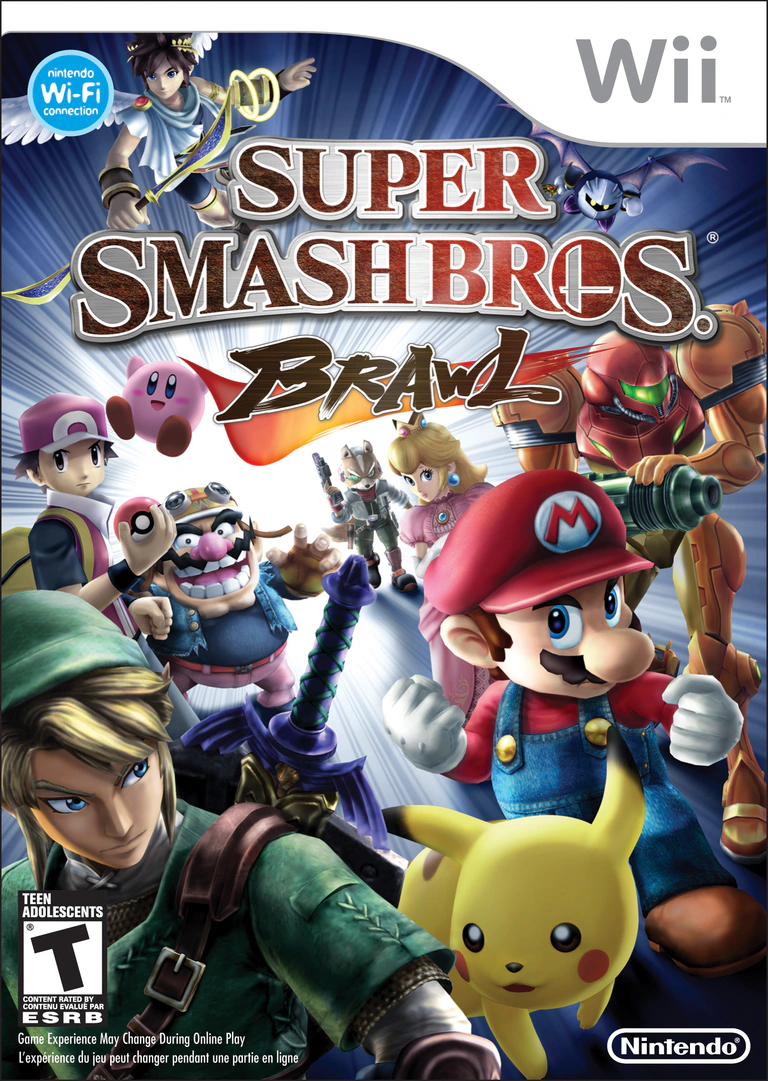
He also appeared in Super Smash Bros. Brawl, as an unlockable character once more. To unlock him, the player had to play 22 brawls, complete Classic mode without using continues, or simply get him to join you in The Subspace Emissary. Luigi's white color scheme in Super Smash Bros. Melee and Super Smash Bros. Brawl resembles Luigi's colors in Super Mario Bros.. He was strong, had fast attacks, and was a middle weight. However, he had the lowest traction and very slow movement in both air and ground. He also seems to be more prone to tripping than all the other fighters in Brawl.
In Super Smash Bros. and Super Smash Bros. Melee, Luigi's voice is just a high pitched variation of Mario's voice. In Super Smash Bros. Brawl though, his voice sounds just like his basic voice in many Mario series titles.
Solid Snake codec conversation
Snake: That guy with the mustache...
Colonel: Ha. You mean the "King of Second Bananas"?
Snake: Hey, that's Luigi! Show him a little respect!
Colonel: Look at that pale skin. He's been living in his brother's shadow for too long.
Snake: That's a low blow, Colonel!
Colonel: Face it, Snake! Once a kid brother, always a kid brother!
Snake: Colonel, what's gotten into you?!
Colonel: La li lu le lo. La li lu le lo. La li lu le lo.
Snake: Colonel, snap out of it! Colonel!! COLONEL!!!!!!!!!!!!!!!!!!!!!!!!!!!!!!!!!!!!!!!!!!!!!
Role in Adventure Mode: The Subspace Emissary

Luigi first appeared where he pretends to threaten and attack on-coming Waddle Dees. They were harmless and made no move to attack him, but he was frightened by them, nonetheless. Then, out of nowhere he was attacked from behind by King Dedede, who slammed Luigi with his mallet, sending him flying into the air. After he came back down, he became a trophy. King Dedede placed him on the road as bait for Wario, who was coming down the road. Wario took the bait, and Dedede managed to steal the princess and Ness trophies along with Wario's Cargo.
Dedede placed a special badge on Luigi, Ness, and the princess, though the princess's badge was knocked off when Bowser flew off with the princess in his Koopa Clown Car and was later swallowed by Kirby. Later, when Tabuu turned everyone into trophies, the badges turned Luigi and Ness back into living creatures. The badges had the power to bring trophies back to life. Luigi and Ness afterward turned King Dedede back to life. The unlikely trio set off to help out Mario, Donkey Kong, Samus, Fox, Link, Yoshi, Pikachu, Captain Falcon, Marth, Mr. Game & Watch, Falco, Pit, Captain Olimar, Lucas, Diddy Kong, the Pokémon Trainer, and Ike. Luigi, along with Ness, then watch Dedede fight Bowser, and later help him convince Wario to join them. After they turned everyone back to normal, they all fought Tabuu.
Other appearances
Luigi was the second best "property" in Nintendo Monopoly, losing only to his famous brother, Mario. Here, he replaces Park Place and costs $350.
Physical appearance
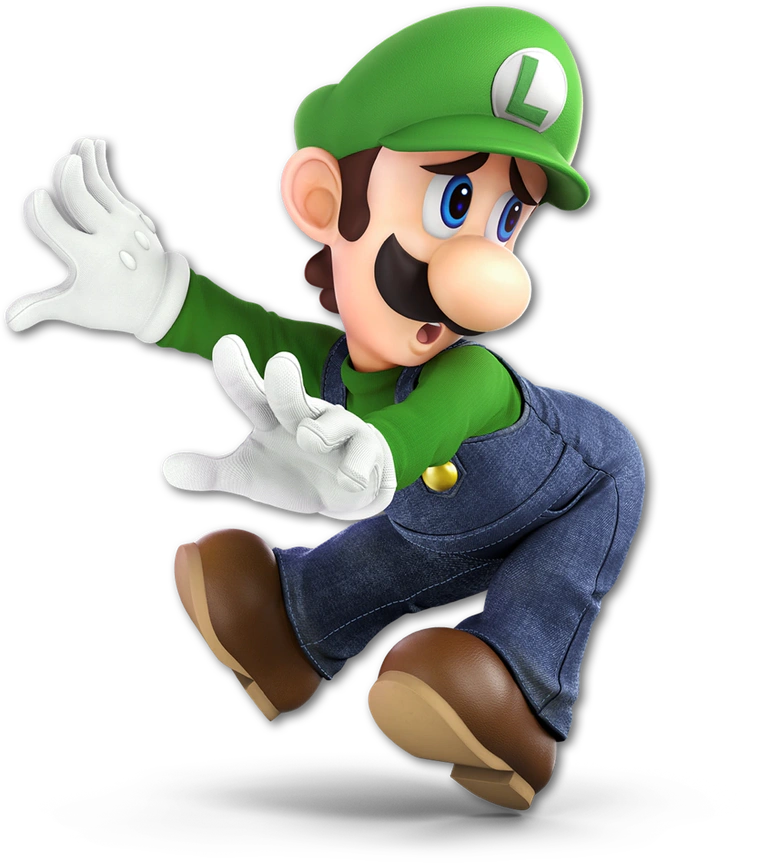
Luigi is very similar to his older brother in appearance, although Luigi is slimmer and taller. His face is notably thinner and chinless. Luigi has a smoothed mustache and light blue eyes. He wears unfaded denim jean overalls, brown work shoes, and a green long-sleeve shirt. Luigi's Cap is similar to Mario's Cap, being green instead of red and having an "L" replace Mario's signature "M." Artwork for the Mario & Luigi series has consistently depicted Luigi as wearing red and white striped socks; this trait is not present in any other games.

Mario and Luigi's color preferences are reflected throughout the land in the form of various enemies, such as Koopa Troopas and Cheep Cheeps, who also come in red and green varieties. These foes even reflect the brothers' personalities, with red ones being more aggressive and green ones acting cautious. In fact, Mario and Luigi are not the only known red and green brothers, with similarly color-coded siblings including Cork and Cask, Red and Green, the Armored Harriers, and Gigi and Merri. When tattling the younger of the Armored Harriers, Goombella theorizes that it may be some sort of rule that younger brothers must wear green, offering a possible explanation for Luigi's trademark green shirt and hat.
However, Luigi has not always chosen to wear his usual green and blue clothes. Mario Bros. originally dressed Luigi in a black shirt and green overalls, although artwork showed his shirt to be red. Wrecking Crew egregiously gave him a magenta pair of overalls and helmet, seemingly leaving him shirtless. Even Super Mario Bros. gave its Luigi a green shirt and white overalls (although Super Mario Bros. Deluxe replaced this with a less aberrant brown shirt and green overalls, leaving his original colors to Fire Luigi, who usually has an inverse scheme), despite the fact that his usual palette and appearance had emerged in artwork.
Luigi is rather infamous for being a palette swap of Mario in his earlier adventures. This applies to Mario Bros., Wrecking Crew, Super Mario Bros., Super Mario Bros. 3, Super Mario World, Super Mario World 2: Yoshi's Island, and even the rare solo quest that is Mario is Missing!. Luigi's first unique sprites came in Super Mario Bros. 2, in which his artwork appearance conveniently coincided with the tall Mama's sprite. Nintendo of Japan would not adapt Luigi's artwork differences to his in-game sprite until Super Mario Kart, although Luigi's various models have been unique almost ever since, even in remakes of games where he was originally a palette swap (such as Super Mario All-Stars, Super Mario All-Stars + Super Mario World, Super Mario Advance 2, and Super Mario Advance 4).
Both Mario and Luigi have been described as "cutesy," to the extent that Shigeru Miyamoto considered redesigning them to "become a bit more grown-up" in the Nintendo GameCube era, for instance by removing their trademark V sign. However, aside from growing more realistic as graphics have advanced, Luigi and his brother have changed little over the years, and continue to flash the V sign regularly.
Luigi's appearance does, however, tend to lend itself to heavy stylization. The Luigi's Mansion graphical team took it upon themselves to animate every part of Luigi to convey emotion, resulting in such exaggerations to the plumber's body as head-expanding screams during boss cutscenes and complete flattenings by fake doors. The Super Smash Bros. series applies Luigi's cowardice to his actions, making most of his attacks look reckless and unwilling and giving him awkward movements, securing his official title as the series' "dreamy, comical poster boy."
Personality
Luigi is portrayed as timid and a bit of a coward. He also worries and is considerably self-conscious. However, he overcomes his fears and acts like a hero when necessary. On the New Super Mario Bros. Wii website, it describes Luigi as "Mario's fearless brother". In keeping with his personality-based Power Flower, a sign in Big Boo's Haunt in Super Mario 64 DS describes Luigi as "wispy."
Arguably, Luigi's most apparent trait is his seeming cowardice. This was not seen until Luigi's Mansion (aside from a few hints in Paper Mario), but it has carried over to almost all of Luigi's subsequent appearances. Although Luigi's phasmophobia is his most overbearing fear, he usually reconsiders at the mere thought of any monsters or trials, especially in the Mario & Luigi series. However, Luigi can be quite brave, and has saved the Mushroom Kingdom alongside his brother multiple times. Super Paper Mario especially glimpses into Luigi's more courageous side, showing him boldly rushing into dangerous situations and rarely even implicating his cowardliness.
Another strong element of Luigi's personality is his apparent complex over being overlooked. Although his Superstar status has earned him many fans, including an entire fan club led by Toadia and multiple supporting Toads (one of which claims to be his biggest fan in Super Mario 64 DS), even Bowser sometimes has trouble remembering his name (as seen in Mario & Luigi: Superstar Saga), and he appears to be almost unknown in the Beanbean Kingdom. Although Luigi's biggest reactions to his frequent overlookings in the Mario & Luigi series are a few "..."'s and facefaults, his inattention was played up for comic relief in Paper Mario, with the snarky man in green complaining about being left behind and perpetually training for that elusive next adventure. Luigi's bio in Mario Party 5 states that he has been gaining popularity in recent years.
Luigi's state of being in the shadow of his brother shows strongly in Super Smash Bros. Brawl. An example would be the way Luigi is almost never happy, how his commentary is very monotoned, and how one of his taunts is a bashful kick of the ground. Also, his Final Smash, Negative Zone, seemed to have developed because of living in his brother's shadow forever. Additionally, whenever the crowd cheers for Luigi, not too many people are heard cheering for him and when the announcer says Luigi's name, he sounds a little surprised. Despite this, however, Masahiro Sakurai did not intend to play up Luigi's overshadowed status, instead aiming to make him "everyone's favorite man in green."
When Luigi finally went on a quest of his own in Paper Mario: The Thousand-Year Door, he's presented as be more arrogant and somewhat of a liar, as he changes the stories of his adventure to make himself look better; his partners claim his stories are false. The novelizations of his escapades describe them with even more flowery exaggerations, stating for instance that he played an earth spirit in the Jazzafrazz Town Drama Slam (whereas he actually played grass on the side of the road, according to Hayzee) and that he awoke Cranberry with "a soft call" (rather than a sneeze).
Luigi is also portrayed as somewhat refined, leading the "Luigi Gentlemen" in Mario Superstar Baseball. Luigi's Mansion shows him to be a bit of a neat freak, constantly criticizing the dustiness of his mansion and even mentioning at one point that he handwashes his cap as opposed to using a washing machine as his brother does. He also seems to have an eye for art, but doesn't appreciate many of King Boo's decorations. Like Toadette, Luigi can be sensitive when someone insults him, especially if the jab in question regards his mustache (as proven prior to his showdown with Dimentio).
Whereas Mario rarely speaks aside from numerous yells and grunts (a point is made out of this in Super Mario RPG: Legend of the Seven Stars with Toad and The Thousand-Year Door with Doopliss), Luigi is proven to be quite the conversationalist in the Paper Mario series. In Super Paper Mario, Luigi is almost Mario's "mouth." He does all the speaking for Mario in the beginning of the game (a role later taken by Tippi). Once he joins Mario's party, however, he only talks during scenes where the four heroes are shown together. Curiously, the inverse seems to be the case in the rare instance of a Luigi-only quest; both brothers are capable of captioned speech in Luigi's Mansion, but Luigi is limited to ellipses and question marks when interacting with another character. In the Mario & Luigi series, Luigi, as well as Mario, talks in gibberish that the player can't interpret, but the other characters in the game do.
In The Super Mario Bros. Super Show! Luigi is consistently portrayed as being the smarter of the two, but the cowardice trait is also shown as Luigi is scared of things going very wrong. He also doesn't take as many risks as Mario does.
Overall, Luigi's personality is hard to determine and tends to change depending on the appearance. Very few games have portrayed him with a personality that lasts throughout the subsequent release. Overall, however, Luigi can be described as timid and cautious, yet kindhearted and willing to protect his homeland with Mario's help - It is perhaps this irony, the basis of Luigi's character, that makes his personality so complex.
Voice
Luigi's voice has varied in different games, unlike his brother, whose voice has basically remained unchanged since Super Mario 64. Luigi has had a high and low quality voice in many of his appearances. His voice sounds much like Mario's, retaining the characteristic Italian accent but with a lower pitch and different tone. The player can sample this in the Mario Party series when the player chooses him or gets a star. Two notable quotes he'd say are "Good choice" (Mario Party 3) and "Yeah, Luigi has got it again!" (Mario Party 6). Luigi was first given a voice in-game in Mario Kart 64, where he originally had a very high-pitched variant of his usual voice, although his clips were re-recorded much lower for the game's English release. (His original voice, however, survived in all releases of Mario Party, Mario Party 2, and Mario Kart: Super Circuit.) Although his lower-pitched voice has mostly stuck, the first two games in the Super Smash Bros. series merely sped up Mario's voice clips (from Super Mario 64) to create Luigi's voice, though Super Smash Bros. Brawl gives him his usual lower-pitched voice just like in Super Mario Galaxy.
Almost invariably, Luigi's voice has been supplied by Charles Martinet in games. Martinet invented the voice after fans requested to speak to Luigi through Mario in Real Time - Although a Luigi in Real Time does not exist, Martinet compromised by allowing Luigi to "come into the TV set for spaghetti" alongside Mama and Papa, all conversing with Mario. Prior to Martinet, Mark Graue gave Luigi a very high-pitched Brooklyn accent in Hotel Mario, and Danny Wells and Tony Rosato gave Luigi cautious, wavering Brooklyn accents for the cartoon series. John Leguizamo also gave his portrayal of Luigi a Brooklyn accent for the movie.
Age
Originally, Luigi was introduced as Mario's younger brother. The first indication of their specific age difference was in "Family Album "The Early Years"", which implied that Luigi was born after Mario by several years. However, Super Mario World 2: Yoshi's Island and Yoshi Touch & Go described the brothers as twins. The remake of the game, Yoshi's Island: Super Mario Advance 3, did not expressly call them twins, but noted that Luigi was Mario's younger brother, carried to their parents at the same time. However, many video game sources still refer to Luigi as the younger brother, indicating that Luigi may have been the second born twin, regardless of his delivery by the Stork. Since Luigi is still said to be Mario's younger twin brother it can be assumed that he was born right after Mario, making them just about the same age. In Super Paper Mario, Luvbi refers to Mario and Luigi as twins at the end of chapter 7-1. It should be noted that in the same game, though, Luigi referred to Mario as "big bro" on more than one occasion. Also, Luigi's Trophy description in Super Smash Bros. Brawl also referred to him as "younger twin brother". However, Colonel Roy Campbell calls Luigi a "kid brother" to Snake during Snake's Codec conversation in the same game. The 1993 film states that Luigi is so much younger than Mario that Mario was the one who raised him.
Abilities
As to not give players advantages over each other, Luigi's abilities are usually exactly the same as Mario's, such as in Mario Bros., Super Mario Bros., and Super Mario World. (Super Mario Bros. 3 is the exception to this rule.) In most instances where one player can choose between the two brothers, however, Luigi is given his own gameplay quirks. This first occurred in Super Mario Bros.: The Lost Levels, where Luigi can jump higher than Mario but has lower traction and speed. In the American Super Mario Bros. 2, Luigi once again features the highest jump, but comparatively low speed and power. Luigi's high jumps but low traction would return in Super Mario World: Super Mario Advance 2, which, unlike its original version, allowed players to switch between Mario and Luigi at any time on the map screen. In three-dimensional adventures, such as Super Mario 64 DS and Super Mario Galaxy, Luigi is usually faster than Mario (at the cost of poorer acceleration), but retains his classic high jumps and poor traction.
As aforementioned, Luigi has a higher top speed but poorer acceleration than his brother in Super Mario 64 DS, along with poor traction and increased agility. In this game Luigi along with Yoshi are the fastest swimmers. Luigi's jumps are perhaps at their strongest in this game; not only can Luigi jump higher than his brother, but he can also scuttle to slow his fall. His backflip has the same effect as being caught in a Tweester or stomping a Fire Guy, allowing for a very slow descent. Unlike Mario, however, Luigi cannot Wall Jump in this game. As a result of his agility and lightness, Luigi can walk on water for a short time. Luigi's Power Flower is Vanish Luigi, allowing him to disappear for invincibility and the ability to walk through certain obstacles.
In Super Paper Mario, Luigi's specialty is the Spring Jump, which sends him just off the screen to bound over obstacles and damage enemies mid-air. His standard jumps are also higher than any other character's and he has lower traction once more.
Electricity is sometimes depicted as Luigi's answer to Mario's fire. In Mario & Luigi: Superstar Saga, Luigi is given the ability to harness and release electricity with a technique known as the Thunderhand (alongside his other specialty, the High Jump). This is referenced in Super Paper Mario with Mr. L's nickname of "The Green Thunder," and in Mario Strikers Charged, where Luigi's Mega Strike involves controlling electricity.
In addition to actual gameplay differences, Luigi often executes his moves differently than his brother. In Super Mario All-Stars + Super Mario World, Luigi jumps with his legs back and descends with them forward, kneels when sliding, and, interestingly enough, appears to spit fireballs rather than throwing them. The Super Smash Bros. series and Mario Kart: Double Dash!! give Luigi green fireballs, and in the former games his fireballs levitate. Perhaps most famously, Luigi's jumping animation in Super Mario Bros. 2 is merely his walking animation sped up; although Luigi's "kicking" jumps were momentarily ignored, they returned in the Super Mario Advance series, complete with a high-pitched warbling sound effect in Super Mario Advance 2 and 4. Luigi's aforementioned scuttle from Super Mario 64 DS also involves walking in mid-air, and the Eternal Understudy "kicks" during his Triple Jump in Super Mario Galaxy.
Luigi has also exhibited many unique traits in various sports and spin-off games, despite usually being a balance character like his brother. In games such as Mario Kart Wii, Luigi has a higher top speed than Mario, but has lower handling and acceleration. In the Mario Golf series, Luigi his with less power than his brother but features better control, although his shots consistently curve left. Luigi is slightly faster than Mario in Mario Superstar Baseball, and reveals his special pitch and swing (the Tornado Ball and Tornado Swing, respectively) in Mario Super Sluggers.
Despite his skills, Luigi is also somewhat clumsy. For example, in Paper Mario: The Thousand-Year Door, he accidentally bumps one of his partners, Blooey the Blooper, into a volcano while trying to stop evil, burning him to a golden crisp but not killing him. Usually, though, he is very agile and can do many stunts Mario can not, and in fact appears to be the best jumper in the Mushroom Kingdom.
Roles
Luigi is a hero, but usually a sidekick, although in some media and games he is referred to as a partner. In the Mario & Luigi games, he is the cowardly partner to Mario, and is occasionally forced to be brave. He is the hero of a separate adventure the player doesn't get to play or see in Paper Mario: The Thousand-Year Door, where he is a coward who changes the story to make himself look more heroic. In Super Paper Mario he was not a sidekick, but rather one of the four heroes, which made him equal to Mario. In Mario is Missing! and Luigi's Mansion, Luigi is the sole main character who had to rescue Mario.
Bowser
Bowser is Luigi's first enemy. Luigi and Bowser have almost always been enemies, but Bowser's main rivalry is with Mario. It may be worthy of note that, in Super Paper Mario, Luigi was seemingly unaware of Bowser's almost clichéd past attempts, stalling to realize that Bowser was the sort of person who would kidnap Princess Peach, and even then not remembering Bowser's name until he actually encountered the Koopa King. Similarly, Bowser does not recognize Luigi when they meet in Mario & Luigi: Superstar Saga, although he does remember who he is in Super Paper Mario.
Mario
Mario is Luigi's older twin brother. Luigi often joins Mario in missions to save Peach, but Mario tends to go on adventures without him. Despite their lifelong sibling rivalry and Luigi's jealousy toward Mario, Mario and Luigi have always maintained a unique "brotherly love" for each other which is further proven when Luigi rescues his brother in Mario is Missing! and Luigi's Mansion. Baby Mario himself aided Yoshi in Luigi's rescue in Super Mario World 2: Yoshi's Island and Yoshi's Island DS. Luigi also has a great admiration for his older brother and looks up to him, wishing to be "a great plumber like [his] brother Mario" in Super Mario RPG. Mario and Luigi are automatic partners in most games.
Princess Daisy
As previously noted, one of Princess Daisy's only appearances between Super Mario Land and Mario Tennis was in NES Open Tournament Golf, where she caddied for Luigi just as Peach did for Mario; this would be Luigi's first documented interaction with Daisy. After Daisy appeared as an optional automatic partner for Luigi in Mario Tennis, Luigi and Daisy have been portrayed as a couple on numerous occasions, such as in Mario Golf: Toadstool Tour, where they are seen golfing alongside Peach and Mario. Some of their team names from the Mario Party series include "Steady Sweeties," "Tango Tanglers," and "Shy Sidekicks." Perhaps the most telling occurrence was in Mario Power Tennis, wherein Daisy says to Luigi, "Hey, sweetie! I'll take that," while receiving her trophy from Luigi. Also, in Mario Superstar Baseball and Mario Super Sluggers, Luigi and Daisy are "buddy players," and they share very good chemistry. Most recently, in Mario Kart Wii, there are two giant statues on the Daisy Circuit that, one shows the two holding hands and dancing together while the other shows them together as babies. Nintendo's only official word on this matter came in Super Smash Bros. Melee, where Daisy's trophy biography states, "After her appearance in Mario Golf, some gossips started portraying her as Luigi's answer to Mario's Peach".
Princess Peach
Princess Peach is portrayed to be Luigi's very close friend. Luigi has also had a little crush Peach. In any game where Luigi can switch Mario for the same role, Peach reacts to him in the same manner she does to Mario, like in New Super Mario Bros., where Peach will give Luigi a kiss after he saves her. Similarly, Super Mario Galaxy 's identical storyline for both Bros. has Rosalina referring to Peach as both Mario and Luigi's special one. Luigi is seen swooning over Peach after she blows a kiss in her Mario Power Tennis victory scene. They were both together in Mario Power Tennis in Diddy Kong's and Koopa's endings. In Super Paper Mario, Luigi comes to Peach's rescue in an attempt to stop Count Bleck and the wedding between Peach and Bowser, focusing on Peach rather than attempting to save Mario. The two share chemistry in Mario Superstar Baseball, and are called Green Eschort in Mario Party 5. In Super Mario Galaxy after finish the story line with Mario and play as Luigi. At the end of the game Peach and Luigi fly away holding hands, the same with Mario.
Rosalina
Rosalina met Luigi in Super Mario Galaxy. Luigi helped her by aiding Mario in retrieving the Power Stars. In Battlerock Galaxy, he tells Mario that he'll only give him the Green Star if he tells Rosalina that he found it for her. Strangely, Mario never does tell Rosalina that Luigi found it. Upon collecting all 121 stars with both Mario and Luigi, Mailtoad sends a picture when the player talks to him in the Grand Finale Galaxy. Luigi's picture shows him, Rosalina, and the Toad Brigade with Peach's Castle in the background, while Mario's picture is of Mario, Peach, and three Lumas on the first planet of Good Egg Galaxy.
Toad
Toad directly adventured with the brothers in Super Mario Bros. 2. Besides giving Luigi tips and the occasional pick-me-up, Toad doesn't spend nearly as much time with Luigi as he does with Mario. The various Toads' opinions of Luigi in Super Mario 64 DS greatly differ from one another, with one denying that he could have retrieved so many Power Stars and another referring to Luigi as "The world's most inept and least charismatic brother," while another refers to himself as Luigi's biggest fan and another states that "We'll have to call you the Luigi Brothers soon!". Toads also acted as Luigi's major allies in Luigi's Mansion, giving special items (such as keys) and allowing the player to save their game. In the Mario cartoons, Toad appears as both a helper and a close friend of Mario and Luigi. Toad has been on good terms with Luigi for a very long time.
Waluigi
Waluigi nurtures an especially hostile grudge against Luigi for unknown reasons, but their rival is parallel to Mario's and Wario's. In Mario Tennis, Luigi made a gesture at Waluigi which Waluigi reacted negatively to. It is stated in the Mario Party 4 guide that Luigi has a crush on Daisy and so does Waluigi. This might be a reason that the two share rivalry. In all, they have bad chemistry in all the games they appear in together.
Wario
Wario was saved from Chief Chilly by Luigi in Super Mario 64 DS. In the past, Baby Wario saved Baby Luigi from Kamek along with Yoshi and other characters in Yoshi's Island DS. Wario seems to have a competitive rivalry with Luigi, as shown when they argue over whether being a superstar requires brains or brawn in the Mario Party introduction. Wario also enjoys tying Luigi's shoelaces together.
Yoshi
Yoshi is one of Luigi's closest friends, but Yoshi's true friendship is with Mario. Luigi and Yoshi are often seen going on adventures together alongside Mario, playing the roles as the second or third playable characters. In most spin-off games, Luigi and Yoshi are commonly referred to as 'The Green Team' if they are both partnered up together, and they are both usually known as Mario's Green Sidekicks by most gaming fans. Although Yoshi is Mario's best friend, Luigi is concidered to be Yoshi's second best friend, as they both show connections to each other like true friends would. They also get along well in Mario Superstar Baseball and Mario Super Sluggers, as they both share Good Chemistry.
Sources
Adapted from the original article, under GFDL 1.3.