Lore
Hylian (Language)
Main language used in Hyrule
Hylian, also referred to as Hyrulean, is the main language used in Hyrule. Throughout the Timeline, many forms and iterations of both written and spoken Hylian have appeared, sometimes being interwoven and revived across whole eras. There are presently six forms of Hylian confirmed to be used by the residents of the Kingdom of Hyrule, and many more languages used by other species as well.
Mudoran
Mudoran is the iteration of Hylian (Language) text that appears in A Link to the Past. Unlike later Hylian scripts, Mudoran is unintelligible. It is found on various important rocks and pedestals.
Era of the Hero of Time
The Hylian writing system from the Era of the Hero of Time was introduced in Ocarina of Time and later appears in Majora's Mask. It is a syllabary based on Japanese Kana, merging both Hiragana and Katakana. However, unlike these scripts, this syllabary lacks sutegana and uses full sized characters for Yōon and Sokuon. It also lacks punctuation marks, such as Chōonpu, as well as distinction for diacritical letters via Dakuten and Handakuten, limiting the full dexterity of the syllabary when emulating Japanese text.
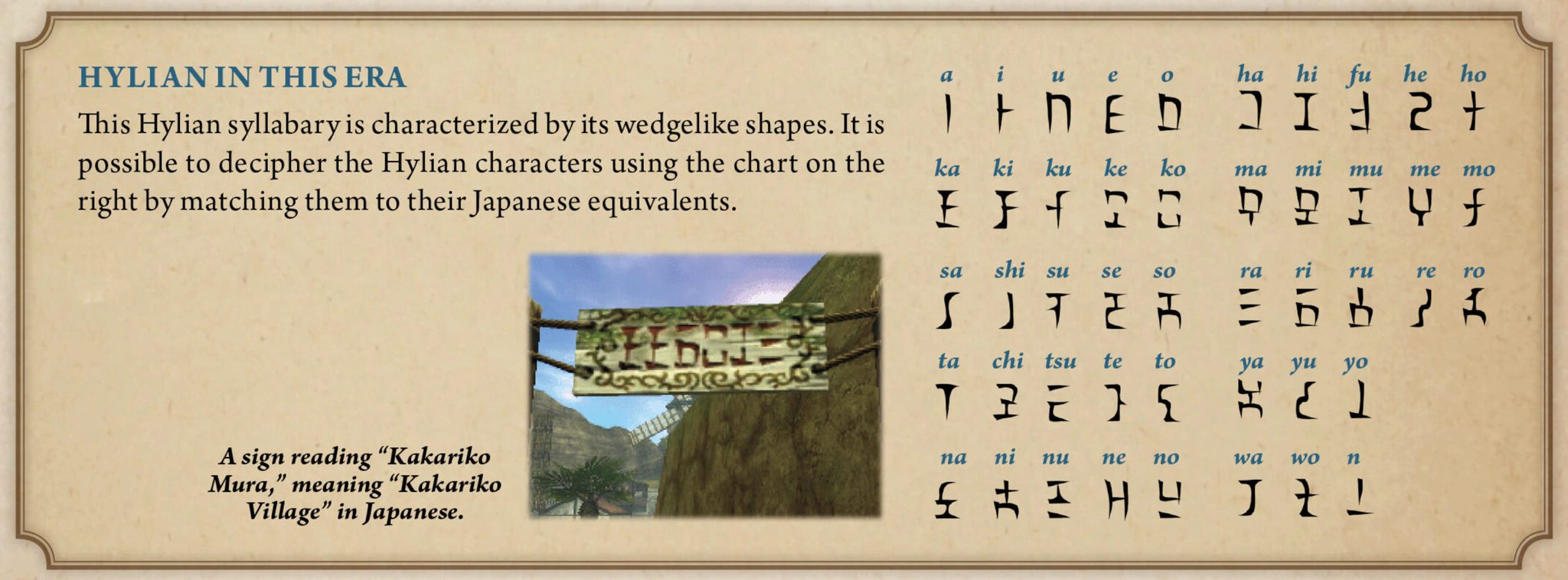
This syllabary appears all throughout Hyrule and Termina on signs and architecture.
- style="color: #000000;" Character map (Era of the Hero of Time) - Monographs (Gojūon) Digraphs (Yōon) - a i u e o ya yu yo - ∅ ア}} イ}} ウ}} エ}} オ}} - あ ア a い イ i う ウ u え エ e お オ o - K カ}} キ}} ク}} ケ}} コ}} ヤ}} ユ}} ヨ}} - か カ ka き キ ki く ク ku け ケ ke こ コ ko きゃ キャ kya きゅ キュ kyu きょ キョ kyo - S サ}} シ}} ス}} セ}} ソ}} ヤ}} ユ}} ヨ}} - さ サ sa し シ shi す ス su せ セ se そ ソ so しゃ シャ sha しゅ シュ shu しょ ショ sho - T タ}} チ}} ツ}} テ}} ト}} ヤ}} ユ}} ヨ}} - た タ ta ち チ chi つ ツ tsu て テ te と ト to ちゃ チャ cha ちゅ チュ chu ちょ チョ cho - N ナ}} ニ}} ヌ}} ネ}} ノ}} ヤ}} ユ}} ヨ}} - な ナ na に ニ ni ぬ ヌ nu ね ネ ne の ノ no にゃ ニャ nya にゅ ニュ nyu にょ ニョ nyo - H ハ}} ヒ}} フ}} ヘ}} ホ}} ヤ}} ユ}} ヨ}} - は ハ ha ひ ヒ hi ふ フ fu へ ヘ he ほ ホ ho ひゃ ヒャ hya ひゅ ヒュ hyu ひょ ヒョ hyo - M マ}} ミ}} ム}} メ}} モ}} ヤ}} ユ}} ヨ}} - ま マ ma み ミ mi む ム mu め メ me も モ mo みゃ ミャ mya みゅ ミュ myu みょ ミョ myo - Y ヤ}} ユ}} ヨ}} - や ヤ ya ゆ ユ yu よ ヨ yo - R ラ}} リ}} ル}} レ}} ロ}} ヤ}} ユ}} ヨ}} - ら ラ ra り リ ri る ル ru れ レ re ろ ロ ro りゃ リャ rya りゅ リュ ryu りょ リョ ryo - W ワ}} ヲ}} -style="background:#163d5f" わ ワ wa を ヲ wo - Special characters - Uvular nasal Full stop Comma - ン}} . }} 、}} - ん ン n . . 、 ,
Era Without a Hero
The Hylian writing system from the Era Without a Hero was introduced in The Wind Waker, later appearing in Four Swords Adventures, The Minish Cap, Phantom Hourglass, and Spirit Tracks, and briefly in Twilight Princess. It is a syllabary based on Japanese Kana and Hindu-Arabic numerals. It supports Chōonpu, Dakuten, and Handakuten, but typically lacks sutegana, therefore using full size characters for Yōon and Sokuon. For example, the Japanese and are not differentiated in this writing system, except for a few rare occasions.
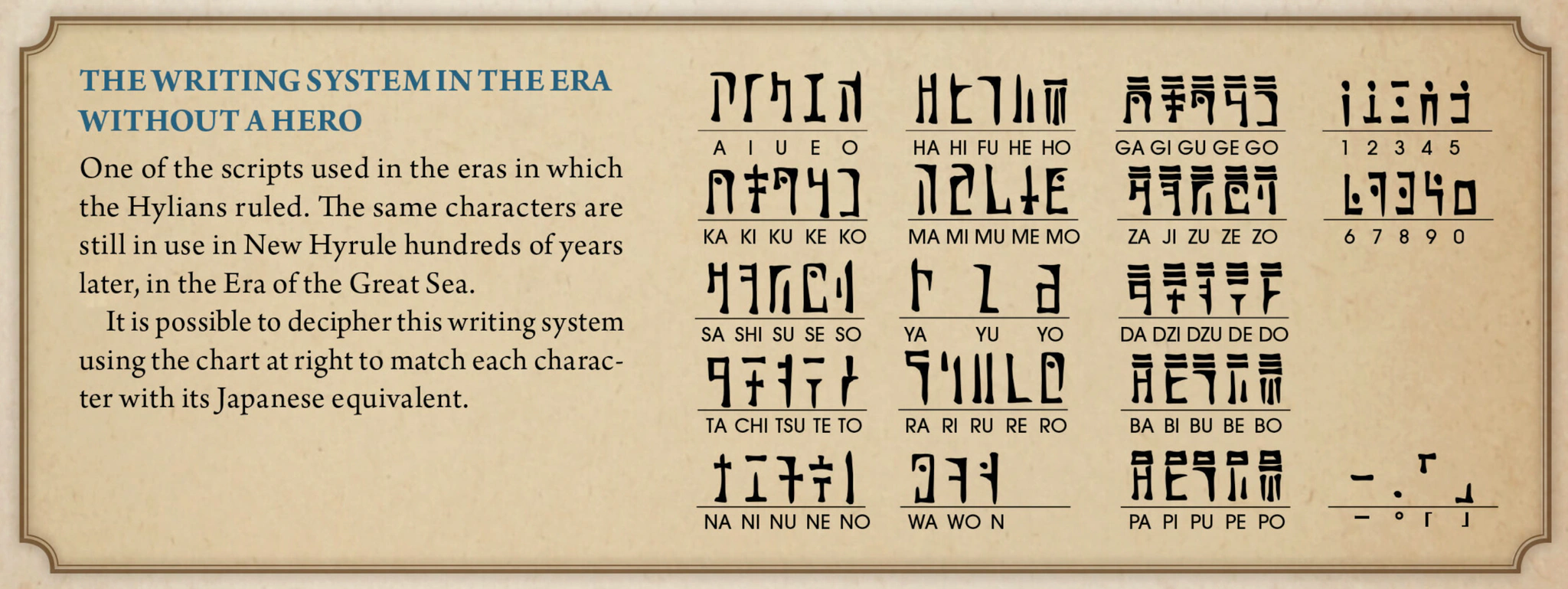
This syllabary is used as early as the Force Era, persisting throughout the Adult Timeline until the Era of Hyrule's Rebirth.
In The Wind Waker, the syllabary appears as an archaic dialect dating back to the Era without a Hero. By the time of the Era of the Great Sea, it had became almost obsolete; its remaining speakers being ancient beings such as the Great Deku Tree, Valoo, Jabun, and the King of Red Lions, as well as the Rito appointed to the role of Valoo's attendant, who learned it to communicate with him. Despite the dialect not widely spoken in the Era of the Great Sea, its syllabary is commonly used throughout the Great Sea and the World of the Ocean King by their inhabitants, and is later carried over into New Hyrule. It makes a small appearance in Twilight Princess on tombstones in Kakariko Graveyard.
- style="color: #000000;" Character map (Era Without a Hero) - Monographs (Gojūon) Digraphs (Yōon) - a i u e o ya yu yo - ∅ ア}} イ}} ウ}} エ}} オ}} - あ ア a い イ i う ウ u え エ e お オ o - K カ}} キ}} ク}} ケ}} コ}} ヤ}} ユ}} ヨ}} - か カ ka き キ ki く ク ku け ケ ke こ コ ko きゃ キャ kya きゅ キュ kyu きょ キョ kyo - S サ}} シ}} ス}} セ}} ソ}} ヤ}} ユ}} ヨ}} - さ サ sa し シ shi す ス su せ セ se そ ソ so しゃ シャ sha しゅ シュ shu しょ ショ sho - T タ}} チ}} ツ}} テ}} ト}} ヤ}} ユ}} ヨ}} - た タ ta ち チ chi つ ツ tsu て テ te と ト to ちゃ チャ cha ちゅ チュ chu ちょ チョ cho - N ナ}} ニ}} ヌ}} ネ}} ノ}} ヤ}} ユ}} ヨ}} - な ナ na に ニ ni ぬ ヌ nu ね ネ ne の ノ no にゃ ニャ nya にゅ ニュ nyu にょ ニョ nyo - H ハ}} ヒ}} フ}} ヘ}} ホ}} ヤ}} ユ}} ヨ}} - は ハ ha ひ ヒ hi ふ フ fu へ ヘ he ほ ホ ho ひゃ ヒャ hya ひゅ ヒュ hyu ひょ ヒョ hyo - M マ}} ミ}} ム}} メ}} モ}} ヤ}} ユ}} ヨ}} - ま マ ma み ミ mi む ム mu め メ me も モ mo みゃ ミャ mya みゅ ミュ myu みょ ミョ myo - Y ヤ}} ユ}} ヨ}} - や ヤ ya ゆ ユ yu よ ヨ yo - R ラ}} リ}} ル}} レ}} ロ}} ヤ}} ユ}} ヨ}} - ら ラ ra り リ ri る ル ru れ レ re ろ ロ ro りゃ リャ rya りゅ リュ ryu りょ リョ ryo - W ワ}} ヲ}} -style="background:#163d5f" わ ワ wa を ヲ wo - Diacritics (Gojūon with (Han)dakuten) Digraphs (Yōon with (Han)dakuten) - a i u e o ya yu yo - G ガ}} ギ}} グ}} ゲ}} ゴ}} ヤ}} ユ}} ヨ}} - が ガ ga ぎ ギ gi ぐ グ gu げ ゲ ge ご ゴ go ぎゃ ギャ gya ぎゅ ギュ gyu ぎょ ギョ gyo - Z ザ}} ジ}} ズ}} ゼ}} ゾ}} ヤ}} ユ}} ヨ}} - ざ ザ za じ ジ ji ず ズ zu ぜ ゼ ze ぞ ゾ zo じゃ ジャ ja じゅ ジュ ju じょ ジョ jo - D ダ}} ヂ}} ヅ}} デ}} ド}} ヤ}} ユ}} ヨ}} - だ ダ da ぢ ヂ ji づ ヅ zu で デ de ど ド do ぢゃ ヂャ ja ぢゅ ヂュ ju ぢょ ヂョ jo - B バ}} ビ}} ブ}} ベ}} ボ}} ヤ}} ユ}} ヨ}} - ば バ ba び ビ bi ぶ ブ bu べ ベ be ぼ ボ bo びゃ ビャ bya びゅ ビュ byu びょ ビョ byo - P パ}} ピ}} プ}} ペ}} ポ}} ヤ}} ユ}} ヨ}} - ぱ パ pa ぴ ピ pi ぷ プ pu ぺ ペ pe ぽ ポ po ぴゃ ピャ pya ぴゅ ピュ pyu ぴょ ピョ pyo - Special characters - Uvular nasal Chōonpu Full stop Comma Exclamation mark Question mark Quotation marks - ン}} ー}} . }} 、}} !}} ?}} 」}} - ん ン n ー . . 、 , ! ! ? ? 「」 “” - Numerals - 1}} 2}} 3}} 4}} 5}} 6}} 7}} 8}} 9}} 0}} - 1 1 2 2 3 3 4 4 5 5 6 6 7 7 8 8 9 9 0 0
Twilight Era
The Hylian writing system from the Twilight Era is a cipher based on the Latin alphabet used in English, but with no letter casing. It appears predominately in Twilight Princess on signs and maps throughout Hyrule, albeit with a few lexical errors commonly surrounding Japanese transliteration of English, causing L and R to be used interchangeably. The non-canonical version of the alphabet found in the Wii version of Twilight Princess features its letters flipped horizontally.

In Skyward Sword, the alphabet is found on the box art as well as on walls in the Sealed Temple and Sky Keep.
- style="color: #000000;" Character map (Twilight Era) - A}} B}} C}} D}} E}} F}} G}} H}} I}} J}} K}} L}} M}} N}} O}} P}} Q}} R}} S}} T}} U}} V}} W}} X}} Y}} Z}} - A B C D E F G H I J K L M N O P Q R S T U V W X Y Z
Sky Era
The Sky Era alphabet appears exclusively in Skyward Sword. It is a cipher mostly matching the Latin alphabet, with a few duplicate letters. D is identical to W, E is identical to K, G is identical to Q, I is identical to X, O is identical to Z and P is identical to T, which complicates translations.
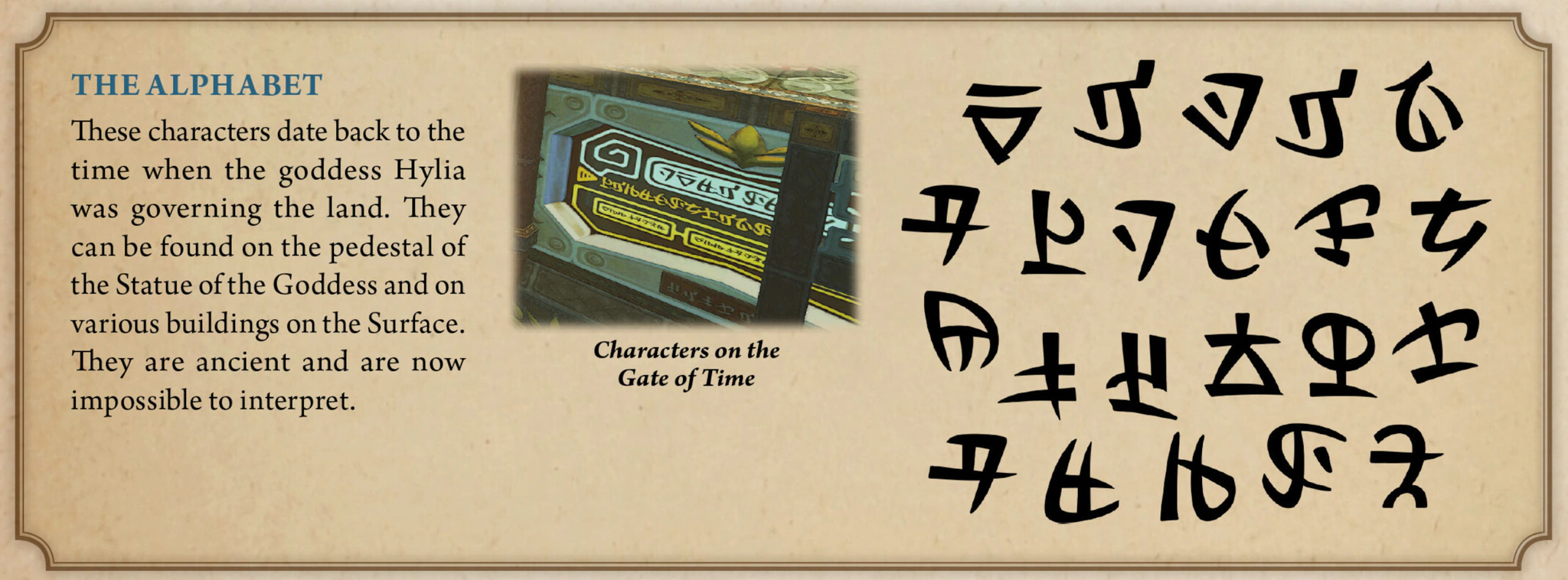
- style="color: #000000;" Character map (Sky Era) - A}} B}} C}} D}} E}} F}} G}} H}} I}} J}} K}} L}} M}} N}} O}} P}} Q}} R}} S}} T}} U}} V}} W}} X}} Y}} Z}} - A B C D E F G H I J K L M N O P Q R S T U V W X Y Z
A Link Between Worlds
The Hylian writing system that appears in A Link Between Worlds, Tri Force Heroes, Breath of the Wild and Tears of the Kingdom is a modified form of the Sky Era alphabet. Both alphabets share some symbols while others are very similar. Several letters in this alphabet map to the same Hylian characters, namely D and G, E and W, F and R, J and T, and O and Z.
Writing appearing in Lorule uses an inverted, but otherwise identical alphabet.
- style="color: #000000;" Character map (A Link Between Worlds) - A}} B}} C}} D}} E}} F}} G}} H}} I}} J}} K}} L}} M}} N}} O}} P}} Q}} R}} S}} T}} U}} V}} W}} X}} Y}} Z}} - A B C D E F G H I J K L M N O P Q R S T U V W X Y Z
Tears of the Kingdom
Tears of the Kingdom continues to use the same script from Breath of the Wild, but also features Ancient Hyrulean from the era of Hyrule's founding which cannot be read by Link. If Link takes a Picture of Ancient Hyrulean text on a Stone Tablet and brings it to Wortsworth in Kakariko Village, he will read and summarize the text for Link. Ancient Hyrulean is written in Middle English, rather than modern English.
Link's Awakening DX
While the Hylian language does not appear in any form, one of the pictures in the DX version contains posters in plain English and Japanese. As Koholint Island is separate from Hyrule, this should not indicate an evolution of the Hylian language, though it has been derived from real life Japanese and English later on.
Sources
Adapted from the original article, under GFDL 1.3.